.png?width=200&height=42&name=%C2%AE%20(200%20x%2042%20px).png)




AI is showing up in more search journeys, and naturally, marketers and brands are asking a new question:
If ChatGPT is answering, will it mention us?
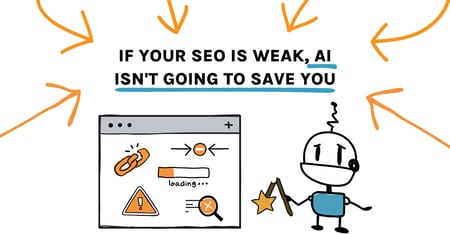
It’s a fair thing to wonder. But the reality is that AI isn’t a workaround for weak SEO.
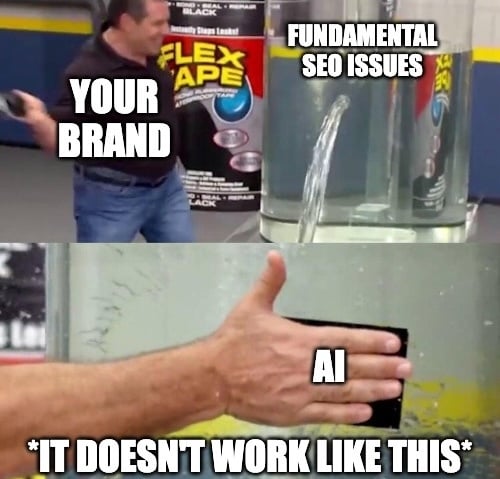
Most AI systems don’t go hunting for overlooked brands. AI systems tend to reflect what’s already clear, credible, and well-established across the web. Which means if your SEO foundation is fuzzy, AI will likely mirror the same gaps.
Fortunately, the path forward is refreshingly familiar for those of us that work in SEO.

Why AI Visibility Feels So Appealing Right Now
For a lot of marketers and brands, AI visibility has started to feel like the next big thing to crack (no, you’re not imagining it).
Search is more competitive, and AI answers show up looking very sure of themselves. Compared to fighting for blue links and shrinking real estate, it’s easy to see the appeal.
There’s also some very real internal pressure at play. Leadership teams are hearing about AI everywhere and asking reasonable questions like, “How do we show up there?” or “Are we behind?”
Put all of that together, and it’s tempting to think AI might level the playing field a bit, and strong answers will rise to the top regardless of who has the biggest SEO footprint.
The catch? AI doesn’t work in a vacuum.
In most cases, it reflects the same signals that shape search visibility: clear positioning, credible mentions, and content that consistently answers real questions. AI visibility often follows the leaders instead of reshuffling the deck (it ain’t as smart as some make it out to be, we promise).
The Reality: AI Reflects What’s Already Strong
Here’s the part that’s less flashy but a lot more useful to understand: AI doesn’t decide which brands deserve attention. It reflects what the internet already agrees on.
Large language models are trained on massive amounts of existing content. Over time, they learn patterns like:
- Which brands are commonly associated with certain problems
- Which tools show up repeatedly in comparisons
- Which companies are consistently described in similar ways
So when a brand appears in an AI-generated answer, it’s typically because those signals were already strong across the board.
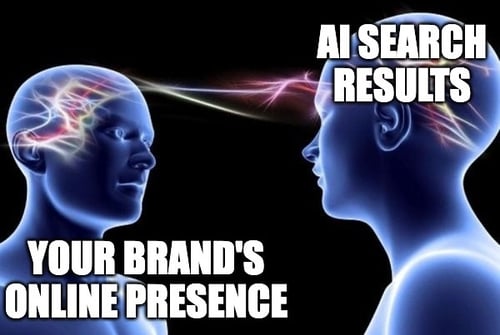
AI can amplify your reputation. It can’t create one from scratch.
That’s why teams with shaky SEO fundamentals often feel disappointed when they test AI visibility.
If your brand:
- Is hard to find in search
- Isn’t clearly tied to a specific use case
- Rarely appears in third-party content
- Or has thin, inconsistent messaging
AI doesn’t have much to work with.
On the flip side, when a brand has clear positioning, useful content, and steady reinforcement online, AI mentions tend to follow. Not because the algorithm picked favorites (it can’t do that), but because the pattern was already there.
Where Weak SEO Quietly Hurts AI Visibility
When brands struggle to show up in AI answers, it’s not because of something new and mysterious. It’s the same foundational issues that have been quietly dragging down SEO for years.
AI just makes the gaps more obvious.
Here are the most common places weak SEO shows up and how to tighten things up.
1. Unclear Positioning
AI has little to anchor to when it comes to brands that aren’t strongly tied to a specific problem or use case.
This happens when messaging tries to cover too much ground or shifts depending on the page, campaign, or quarter. The result: plenty of words, not much clarity.
2. Surface-Level Content
A high volume of content doesn’t automatically build authority, especially if most of it skims the surface.
AI systems tend to favor content that clearly explains or answers real questions. Thin blog posts written purely to hit keywords rarely send strong signals.
3. Weak Authority Signals
A brand that mostly talks about itself can only push the signal so far.
AI visibility is strongly influenced by broader ecosystem reinforcement: reviews, third-party mentions, industry coverage, and credible backlinks. When those are sparse, your brand has less external validation to lean on.
4. Technical SEO Gaps
Not the sexiest topic, but still very relevant.
Sites that are difficult to crawl, slow to load, or structurally confusing weaken the overall signals search engines rely on.
None of these issues are new. AI just makes them harder to ignore.
What Improves Your Odds in AI Answers?
AI visibility is mostly the byproduct of boring-in-a-good-way marketing fundamentals.
There’s no special schema or prompt sorcery.

What moves the needle is strengthening the signals that travel well across the web. Here’s where to focus:
Crystal-Clear Positioning
AI systems (and humans, conveniently) respond best when a brand is easy to categorize.
The brands that show up most often tend to have a clear “best for XYZ” narrative.
If your positioning still reads like it was written to please everyone in a single paragraph, this is the first lever to pull.
Content That Answers Real Buyer Questions
Content built around actual decision-making moments tends to surface more often than top-of-funnel fluff.
Prioritize assets that help someone choose, compare, or understand tradeoffs, such as:
- Comparison pages
- “Best for” breakdowns
- Use-case guides
- Honest pros and cons
This kind of content strengthens both traditional SEO and the patterns AI models pick up over time.
Consistent Brand Mentions Beyond Your Site
Your website tells your story. The rest of the internet validates it.
Brands that appear in AI answers have reinforcement from:
- Industry publications
- Reviews and roundups
- Partner ecosystems
- Community discussions (hi, Reddit)
The goal isn’t to manufacture mentions everywhere but to create enough credible touchpoints that your brand becomes part of the broader conversation.
A Healthy Technical Foundation
Strong crawlability, clean site structure, and solid performance ensure your content and positioning signals are discoverable.
If the technical foundation is shaky, everything built on top of it carries less weight.
Focus on strengthening those signals (and tap us for help if ya need it), and your odds improve in search, AI answers, and anywhere else buyers go looking for direction.
Quick Gut Check: Are You Building Signals AI Can Recognize?
Wondering where you stand? A few honest questions can tell you a lot.

Give your current setup a quick gut check:
Can you clearly state what your brand is best for in one sentence?
When it takes an entire blog (or a full brainstorming session), your positioning may need a little TLC.
Do you show up in credible third-party comparisons or roundups?
Only showing up on your own website is a sign your external signals are thin.
Is your content helping buyers make decisions?
Think comparisons, tradeoffs, and use-case guidance instead of just awareness posts.
Are your core SEO fundamentals healthy?
Crawlability, site structure, and performance still matter more than most teams want to admit.
Is your messaging consistent everywhere your brand appears?
Mixed signals make it harder for both humans and AI to confidently place you.
If you’re nodding along to most of these, you’re on the right track. If a few made you pause…that’s useful too.
The brands that show up most clearly in AI answers aren’t doing anything flashy. Really, they’re sending consistent signals that are easy to recognize.
AI Is a Multiplier, Not a Fixer
AI is changing how people discover and evaluate brands. That part is real.
What it isn’t doing is handing out visibility to teams that skipped the fundamentals.
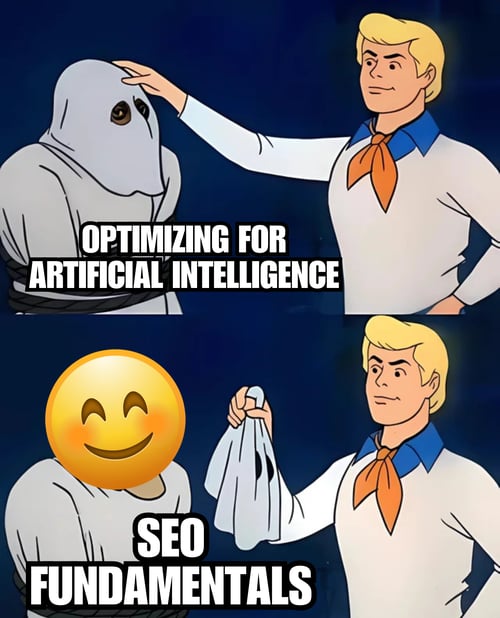
In most cases, AI behaves like a multiplier. Clear positioning and consistent brand presence make it more likely AI-driven answers will reflect that strength. Weak or scattered signals tend to surface the same gaps you’re already seeing in search.
The takeaway isn’t to ignore AI. Instead, you’ll want to focus on the work that compounds across every channel: clarity, credibility, and content that helps people make decisions.
Not sure whether your current SEO and content strategy are sending the right signals? Our team is here to help.
Reach out anytime. We’re happy to dig in and help you make improvements that pay off in search, AI, and wherever your buyers might be looking!


SUBSCRIBE TO OUR BLOG
Stay up to date with the latest industry best practices in digital marketing!















.png?width=339&height=179&name=Webinar%20Banner%20(1).png)



.png?width=339&height=179&name=July%20Webinar%20(Newsletter).png)
.png?width=339&height=179&name=Webinar%20Banner-April-02%20(1).png)
%20(4).png?width=339&height=179&name=Webinar%20Banner-May-02%20(1)%20(4).png)




.png?width=339&height=179&name=March%202023%20Webinar%20Ad%20(autoresponder).png)




.svg)
.svg)
.svg)
%20(1).svg)
.svg)
.svg)

.png?width=339&height=179&name=2025%20Paid%20Media%20(1200%20x%20628%20px).png)





































.png?width=339&height=179&name=2026%20Paid%20Media%20Ad%20Specs%20(Twitter%20Post).png)

.png?width=339&height=179&name=1%20(3).png)