.png?width=200&height=42&name=%C2%AE%20(200%20x%2042%20px).png)




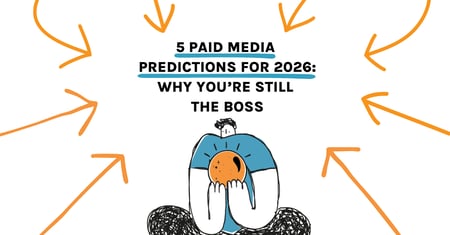
Another year is here, and that means yet another flurry of considerations, changes, and decisions in the digital marketing world! Just because you hammered out your 2026 paid media strategy in Q4 of last year doesn't mean that the platforms and features aren't cooking up something new to roll out at any moment.
Given the ever-changing nature of the space we work in, we wanted to ask the paid media experts at BFO some of their 2026 predictions. Our team is working within these spaces every single day, so we wanted to see what the experts think is coming our way...
1. Performance Max & Gemini: Your Unpaid Awareness Interns
Google designed PMax to be the full-funnel Terminator of campaigns, but let’s be real—it's still a work in progress (much like John Connor in T2).
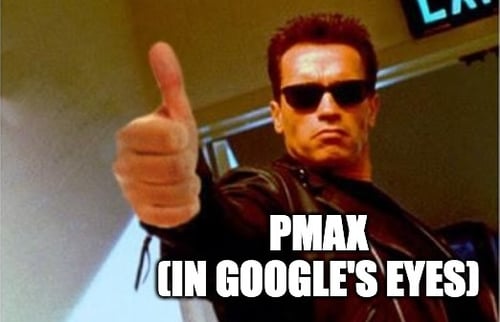
Kelley Pain, our Senior Paid Media Account Manager, believes that Google Gemini will be deeply embedded in the platform, driving more automated decisions around keyword matching, bidding, and creative than ever before.
While this shifts managers away from the "hands-on" knobs and dials of setup, it doesn't mean you're out of a job. The smart money will stop treating PMax as a sales-closing machine and start using it as a high-speed discovery engine. You'll use "Feeder Campaigns" and intentional segmenting to push the budget toward the top of the funnel (YouTube, Display).
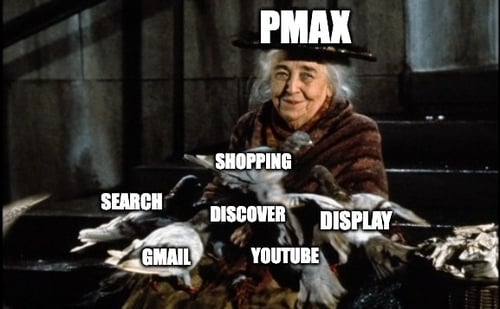
Your new role? Monitoring performance, testing ideas, and—most importantly—correcting or guiding AI-driven decisions when they veer off-course. PMax is great at getting users’ attention, but it’s still up to you to close the deal!
2. Meta Ads & the Rise of "Low-Fi" Video
Toss out the expensive, highly-produced studio ads.
The Meta algorithm is officially anti-Hollywood and is doubling down on authentic, "native-style" content. Our Associate Director of Paid Media, Scott Diebel, notes that video—especially short-form—will continue to dominate because major platforms are now offering native tools that make creation easier and cheaper. With costs per view hitting as low as $0.01 - $0.02, there is no excuse not to play.
Your creative budget should be reallocated from glossy photo shoots to a torrent of quick, simple, (sometimes) emotional, user-generated-style videos. If your ad looks like you spent more than an hour on it, the algorithm is going to punish you for being inauthentic. The platform wants the ad to look like a post from your best friend, not a broadcast from a multi-national corporation.
We’re serious here: Great videos can be made with just a phone and someone from your team... just please remember when to hold the camera vertically and when to use landscape.
3. The "Black Box" Problem & the Trust Gap
As AI takes on the "how" of advertising, it’s also making the "why" harder to see.
James Willingham, our Paid Media Account Manager and resident Basketball Coach, points out a growing reality: AI will become less trusted. Trust in AI's "black-box" attribution is hitting an all-time low. When platforms can't show their work—and often over-attribute those not-always-accurate "View-Through Conversions"—the human marketer must establish the one source of truth they control: their own data.
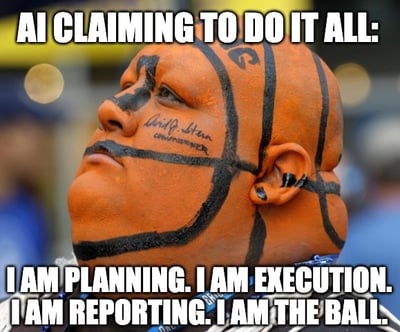
In basketball terms, trusting black-box AI is like relying on a stat sheet that pads its own box score. You can't win the game on inflated numbers; you have to ignore the "View-Through" hype, watch the game film, and focus on the first-party data that actually puts points on the board.
In 2026, your success hinges on First-Party Data. You need to leverage lists of your highest-value assets (loyal customers and qualified leads) to train the AI. Feeding the system data on people who bought your most profitable product is the only way to ensure it chases genuine value, not just cheap clicks.
You'll need independent measurement tools because if you don't keep a watchful human eye on your data, the AI will happily go on a $20,000 spending spree. ← True Story (It happened to a client pre-BFO)
4. Your New Audience is the Algorithm (B2A Marketing)
You’re no longer just running campaigns for Bob in accounting; you are running campaigns for AI Overviews, Chatbots, and Generative Systems (B2A).
The future of ad visibility isn't just about winning a keyword auction; it's about being deemed an authoritative source by an algorithm that decides which brand should be recommended in an AI-generated answer.
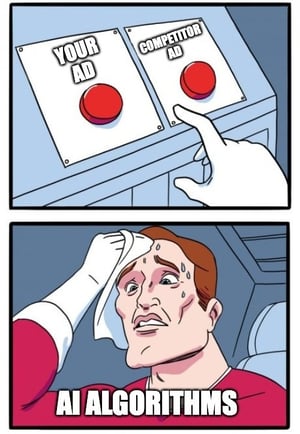
This creates a polarizing landscape for advertisers. Scott Diebel predicts that while some will lean into AI to churn out creative at unprecedented speed and scale, others will lean heavily on human-led creative to set themselves apart and protect brand safety. Your content must be so factually rich and transparent that the AI feels comfortable vouching for you.
5. The New Big Three: Google, Meta, and... AppLovin?
Forget the annual media plan approved in September; media plans that can't pivot in real-time are dead weight. Full stop.
Dear Current, Future, and Former Clients,
Please, for the love of all things marketing, keep your budgets fluid. Let the dollars go where results flow, and don’t handcuff your digital team to budget allocations that were established 15 months ago when the landscape is changing daily!
Both PMax and Meta’s Advantage+ reward flexibility. But you also need to know where to pivot.
Another BFO expert, who splits time between Paid Media & Analytics, predicts a major shakeup in the hierarchy: AppLovin will solidify itself as the 3rd most important marketing channel—at least for E-commerce—trailing only behind the titans of Google and Meta.
The catalyst for this shift is the rollout of their Axon 2.0 AI engine, which has transformed mobile gaming inventory into a high-performance engine for direct-to-consumer (DTC) brands. By leveraging real-time machine learning and high-intent "rewarded" ad placements, the platform is now delivering ROAS figures that rival Meta’s Advantage+ campaigns while offering advertisers access to a massive, underutilized audience of 1.4 billion daily active users.
Wrapping Up (in Time for Holiday)
The winning strategy for 2026 isn't about choosing between human intuition and machine learning; it’s about becoming the strategist who steers the AI. Success requires a shift from manual "knob-turning" to high-level data management—using first-party data to pierce through the "black box" of platform attribution and treating PMax and Gemini as discovery interns rather than solo closers.
To dominate the landscape, advertisers must adopt a 70/20/10 budget model:
- 70% on proven winners (Meta’s "low-fi" video and Google’s core automation).
- 20% on smart experiments (shifting into AppLovin’s Axon 2.0 engine to reach its 1.4 billion users).
- 10% in a "rapid-response" slush fund to capitalize on viral moments and real-time pivots.
Ultimately, you are the head coach of this digital transformation. Whether you are optimizing for AI search recommendations (B2A) or ignoring inflated "box score" stats in favor of your own data film, the goal remains the same: treat the algorithm as a powerful tool, but don't let Skynet take the wheel. You provide the strategy and the whistle; the AI just provides the muscle. And, if you need a hand, our paid media services always here to help!


SUBSCRIBE TO OUR BLOG
Stay up to date with the latest industry best practices in digital marketing!









.png?width=339&height=179&name=Webinar%20Banner%20(1).png)


.png?width=339&height=179&name=July%20Webinar%20(Newsletter).png)
.png?width=339&height=179&name=Webinar%20Banner-April-02%20(1).png)
%20(4).png?width=339&height=179&name=Webinar%20Banner-May-02%20(1)%20(4).png)



.png?width=339&height=179&name=March%202023%20Webinar%20Ad%20(autoresponder).png)





.svg)
.svg)
.svg)
%20(1).svg)
.svg)
.svg)

.png?width=339&height=179&name=2025%20Paid%20Media%20(1200%20x%20628%20px).png)























.png?width=339&height=179&name=2026%20Paid%20Media%20Ad%20Specs%20(Twitter%20Post).png)

.png?width=339&height=179&name=1%20(3).png)