.png?width=200&height=42&name=%C2%AE%20(200%20x%2042%20px).png)




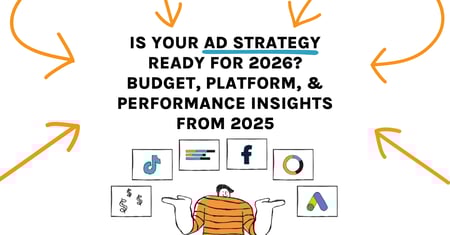
If 2024 was the year AI showed up to the party, 2025 was the year it grabbed the aux.
From Performance Max running the show to Meta’s Advantage+ deciding who sees what, it’s safe to say the ad world got a little...wild.
And somewhere between creative testing and campaign reporting, we all started wondering the same thing: “Wait, who’s actually in charge here?”
Here’s the twist: 2026 isn’t going to calm down. But that’s not a bad thing. Really, it’s a huge opportunity.
Because when everything’s changing this fast, the brands that lean in and learn are the ones that come out ahead.
Below, we’re unpacking what 2025 taught us and how to use those lessons to set yourself up for a smoother, smarter, and yes, more fun 2026.
2025 By the Numbers: What Actually Worked
2025 was quite the ride for paid media. Between the rise of automation-first campaigns and a growing obsession with creative testing, advertisers had to evolve or get left in the algorithm’s dust.
But through all the chaos, some clear winners emerged.
Automation Dominated (But Not Always Perfectly)
Performance Max, Demand Gen, Meta Advantage+. 2025 was peak “machine mode.” Automation handled more targeting, bidding, and placements than ever before.
And when it worked, it really worked.
Campaigns with strong conversion data and clean asset inputs saw major efficiency gains (lower CPAs, higher ROAS, and faster learning, woo!).
But when data quality was off or creative was weak, automation magnified the problem instead of solving it.
Takeaway: Automation is only as smart as the signals you feed it. Your data strategy is your performance strategy.
Creative Became the Differentiator
In 2025, creative took its rightful place at the center of performance.
With AI optimizing placements and bids, the only real variable left was the ad itself.
Brands that invested in diverse creative testing (multiple formats, tones, and hooks) consistently outperformed those who reused the same “safe” assets.
Takeaway: The algorithm delivers impressions. Your creative earns conversions.
Attribution Got Messy (Again)
In 2025, cross-platform tracking blurred, and last-click models became practically meaningless.
The solution? Brands that leaned on first-party data and blended attribution models (like data-driven or full-funnel analysis) got the clearest picture of what was driving results.
Takeaway: The best marketers stopped trying to “fix” attribution and learned how to interpret it.
Budget Efficiency Beat Budget Expansion
The biggest success stories of 2025 were all about who optimized the smartest.
With rising CPCs and tighter budgets, the real winners reallocated funds, shifting spend between platforms based on live performance signals instead of quarterly habits.
Integrated media strategies where paid, organic, and CRM data worked together delivered the strongest ROI.
Takeaway: You don’t need a bigger budget. You need a better one.
How to Spend Smarter in 2026
If 2025 taught us anything, it’s this: You don’t win by outspending. You win by out-optimizing.
The days of “set it and forget it” are long gone (pour one out for simpler times). Platforms are evolving weekly, creative burns out faster than a TikTok trend, and smart advertisers are treating their budgets like living things.
So before you lock in those 2026 numbers, take a beat.
Rethink How You Allocate (and Reallocate)
Static quarterly budgets? No more. In 2026, dynamic allocation is the new standard.
Your spend should flex based on real-time signals, not calendar dates.
That means:
- Shifting budget across channels mid-month based on performance
- Scaling winners fast, cutting losers faster
- Building test budgets into every quarter (because innovation isn’t free)
Think of your budget like a portfolio. You don’t leave money in a bad stock out of loyalty. Instead, you move it where the growth is.
Don’t Feed the Algorithm Junk Data
Before scaling your media budget, audit your data. (Seriously.)
Bad tracking = bad optimization.
Your first investment in 2026 should be in the systems that fuel machine learning:
- Clean conversion tracking and deduplication
- Properly configured GA4 events
- Connected offline conversions
- CRM integrations and enhanced conversions
The better your data foundation, the more accurate your platform optimization becomes. Plus, the less wasted spend you’ll have to justify later.
Test → Learn → Scale
In 2026, the smartest marketers won’t “find time” to test—they’ll bake it right into their media plan.
Don’t wait until Q2 to suddenly try something new. Q1 is your playground. It’s when competition is lighter, and the data you collect will shape everything that comes next.
Start by experimenting with:
- Fresh audiences. New segments, smarter lookalikes, or creative first-party blends.
- Emerging formats. Think YouTube Shorts, LinkedIn Thought Leader Ads, or Reddit Ad placements that feel native.
- Creative variables. Hooks, CTAs, offers, tones, lengths…even the stuff you think won’t work (you’ll be surprised).
Document everything and scale what sticks. By the time everyone else is scrambling mid-year, you’ll already know what performs and why.
Budget for Profit, Not Ego
Your CFO doesn’t care about CTR. (And honestly, neither should you.)
The most successful brands in 2026 will shift their measurement mindset from surface metrics to meaningful outcomes:
- From clicks → to conversions
- From ROAS → to blended CAC and LTV
- From platform data → to business data
When every dollar has to pull its weight, efficiency becomes the operating system.
Where to Play (and Why)
With new features dropping every month and attention spans shrinking by the minute, choosing where to spend in 2026 involves being effective where it matters.
Here’s what delivered in 2025 and what to double down on next year.
Google Ads: Still the Full-Funnel Backbone
Google Ads is still the anchor of most paid media strategies, but it’s not the same Google Ads you grew up with.
Performance Max and Demand Gen ruled 2025, proving that automation can deliver big-time results if you feed it the right stuff.
What’s working:
- Clean conversion tracking and strong creative diversity (video, image, text)
- Using PMax for lower-funnel conversions and Demand Gen for top/mid-funnel reach
- Smart account structures with clear goals instead of overlapping campaigns
What to watch in 2026: Google’s leaning harder into creative automation and predictive targeting, meaning the quality of your assets will make or break your performance.
In other words: give the machine clarity, variety, and guardrails, and it’ll reward you. Starve it or confuse it? You’ll end up in “Why did my CPA double?” territory fast.
Meta Ads: Automation + Storytelling = ❤
Meta’s Advantage+ suite went from interesting to essential in 2025.
Automation leveled the playing field, but creative storytelling? That’s still the secret sauce.
The best-performing brands were feeling the algorithm content that felt human.
What’s working:
- Native-style creative that blends right into the feed (UGC, behind-the-scenes, real people, real talk)
- Frequent creative refreshes to keep fatigue at bay
- Letting Advantage+ audience expansion handle efficiency while you focus on emotional connection
What to watch in 2026: Expect Meta to double down on creator collaboration and organic + paid integration. The lines between ad and content will blur even more, and “polished” will keep losing to “personal.”
LinkedIn: Quietly Crushing It for B2B
LinkedIn’s 2025 growth wasn’t loud, but it was legit.
With new formats like Thought Leader Ads and Document Ads, brands turned once-boring posts into lead-pulling machines. The platform feels less like a résumé wall and more like a B2B storytelling hub.
What’s working:
- Narrative-driven video ads with a human face
- Using lead gen forms synced to CRM systems
- Strategic use of employee advocacy + ad amplification
What to watch in 2026: Higher CPCs will continue, but engagement depth and lead quality justify the cost. If you’re B2B, LinkedIn still deserves its line item. Just budget smart.
TikTok & YouTube Shorts: The Attention Economy, Unfiltered
2025 officially crowned short-form video as the internet’s native language.
TikTok and YouTube Shorts seriously converted.
But here’s the catch: the brands that crushed it weren’t advertising. They were participating. They joined trends, told stories, and leaned into authenticity instead of chasing perfection.
What’s working:
- Authentic, low-production storytelling
- Creator collaborations and Spark Ads
- Cross-posting short-form across YouTube, Instagram Reels, and TikTok
What to watch in 2026: More shoppable video integrations, deeper analytics, and (finally) better attribution. Treat short-form as your awareness engine and retarget from there.
Reddit: The Dark Horse of High-Intent Advertising
2025 quietly turned Reddit into a performance sleeper hit, especially for brands tired of paying Meta and Google premiums for engagement.
With keyword targeting, community-based placements, and improved brand safety tools, Reddit became the go-to channel for authentic interaction (we really ❤ Reddit).
What’s working:
- Native-feeling ads that align with subreddit tone and culture
- Testing in niche communities where passion = performance
- Thread engagement as a research and retargeting goldmine
What to watch in 2026: Reddit’s growing up. Better targeting, better analytics, and a lot more attention from brands trying to join the conversation. Prices may rise, but authenticity will still be the ultimate currency.
Creative & Messaging: Your Unfair Advantage
By 2025, everyone had access to the same AI tools and automation magic. So why did some brands scale while others just…spent money?
Because while the algorithm can optimize delivery, it can’t create connection.
In 2026, your biggest growth lever will be your story.
Creative Is the New Targeting
As automation took over the “who” and “where,” 2025 made one thing clear: your ad creative is now your targeting filter.
The visuals and tone of your ads determine who engages and how deeply.
- Thoughtful hooks attract the right audience before the algorithm even learns who they are.
- Visual storytelling (especially in short-form) defines brand affinity long before a click.
- Authenticity signals trust and trust converts.
Refresh Early, Refresh Often
Creative fatigue is real, and in 2026, it hits faster than your Monday caffeine crash.
With platforms auto-optimizing impressions, even your best-performing assets can burn out in weeks. The algorithm moves fast, so your creative rotation needs to move faster.
Try:
- A creative refresh cycle every 3–6 weeks
- At least 5–10 active variations per campaign
- Ongoing tests across tone, CTA, and format to keep performance steady
The payoff = more consistent learning and a brand that feels alive, not automated.
Storytelling > Selling
Consumers have seen enough ads to spot one a mile away. What they respond to is connection.
Winning creative in 2026 will lean into emotion, empathy, and authenticity.
That means:
- Leaning on customer voices and testimonials
- Using narrative-based ad sequences (awareness → problem → solution → proof)
- Prioritizing clarity over cleverness
Think less “Buy now” and more “Here’s why this matters to you.”
Brand Consistency Across Platforms
We know this one sounds obvious. “Keep your creative consistent.” Duh, right?
But you’d be surprised how many brands still get this wrong.
With campaigns running across Google, Meta, LinkedIn, TikTok, Reddit, and beyond, fragmented creative is a performance killer.
Your brand voice should feel unified, even when the visuals flex for each platform’s vibe.
When your message clicks across every touchpoint, your campaigns start compounding momentum.
How to Future-Proof Your Ad Strategy for 2026
You’ve analyzed the data. You’ve refreshed the creative. You’ve wrestled with the algorithm (and, fine, maybe learned to live with it).
Now comes the real question: How do you build a paid media strategy that can roll with the punches in 2026?
Here’s how the smartest brands are getting ahead before January even hits.
Make Your Budget as Agile as Your Ads
2026 will reward the most flexible spenders.
Ditch the “set it and forget it” mentality. Try this mix:
- 70% → proven performers
- 20% → experimental channels
- 10% → “rapid response” for trends, tests, and unexpected wins
That last slice is your “move fast” fund. It’s the one that lets you jump on what’s working now, not what everyone else will read about later.
Treat AI as a Teammate, Not a Threat
In 2026, AI isn’t the enemy or the magic bullet. It’s your fast, slightly nerdy teammate that makes your job easier if you give it good direction.
Use it to:
- Spot audience shifts and creative fatigue before they tank performance
- Automate your testing and reporting (and reclaim your Fridays)
- Personalize creative at scale without losing your sanity
Just remember: AI doesn’t know your brand’s voice or your audience’s inside jokes. You do.
Let AI handle the math. You handle the meaning.
Go All-In on First-Party Data
Cookie depreciation isn’t “coming soon” anymore. It’s already here.
And if you’re still relying on third-party tracking, your 2026 data strategy is basically running on fumes.
This is the year to double down on first-party data and make it work harder for you.
Focus on:
- CRM integrations that sync cleanly across every paid platform
- Strong opt-in moments through email, SMS, and loyalty programs
- Offline conversion imports for smarter, full-funnel attribution
Your owned data is your competitive advantage.
Focus on Experience, Not Just Exposure
Platforms evolve and algorithms shift. But people are still people (yay?)
.
They want to feel understood, inspired, and valued.
So in 2026, relevance will beat reach every time.
Think frictionless UX, lightning-fast load times, and post-click journeys that deliver on the promise your ad made.
Plan Now, Win Early
The best 2026 campaigns are already being planned right now (AH!).
Your Q1 tests will determine your Q2 scale. Your holiday learnings will shape your summer creative.
So don’t wait for January to “see what happens.”
Get your house in order and step into the new year ready to sprint.
Set Your 2026 Ad Strategy in Motion
The ad landscape isn’t slowing down, but that’s good news for brands that plan and adapt.
Your 2026 success will come from tightening your strategy and giving your campaigns the clarity they need to perform from day one.
Want a little extra help getting there? Now through the end of the year, you can get 26% off any new BFO service to make sure you hit Q1 running!
Learn more here and be sure to send us a message if you have any questions. Let’s make 2026 your most intentional (and most effective) year yet!


SUBSCRIBE TO OUR BLOG
Stay up to date with the latest industry best practices in digital marketing!



.png?width=339&height=179&name=Webinar%20Banner%20(1).png)
.png?width=339&height=179&name=July%20Webinar%20(Newsletter).png)
.png?width=339&height=179&name=Webinar%20Banner-April-02%20(1).png)
%20(4).png?width=339&height=179&name=Webinar%20Banner-May-02%20(1)%20(4).png)
.png?width=339&height=179&name=March%202023%20Webinar%20Ad%20(autoresponder).png)

.svg)
.svg)
.svg)
%20(1).svg)
.svg)
.svg)
.png?width=339&height=179&name=2025%20Paid%20Media%20(1200%20x%20628%20px).png)


.png?width=339&height=179&name=2026%20Paid%20Media%20Ad%20Specs%20(Twitter%20Post).png)
.png?width=339&height=179&name=1%20(3).png)