.png?width=200&height=42&name=%C2%AE%20(200%20x%2042%20px).png)




Not every purchase is created equal.
Sometimes people buy in seconds. Add to cart, checkout, done before the coffee gets cold. Other times, there are spreadsheets involved along with some late-night comparison tabs.
That second scenario is where high-consideration brands live.
A high-consideration brand is one where the buying decision takes time, thought, and a fair amount of pressure. These purchases carry real weight—financially, emotionally, or in terms of long-term impact.
Think: replacing every window in your home. Choosing a university. Selecting a platform your team will rely on for years. We’re not exactly in impulse-buy territory.
On the flip side, low-consideration purchases are the low-stakes decisions people make with minimal research. Grabbing a gallon of milk, tossing a budget accessory into your cart. Blink-and-it’s-done kind of stuff.
If you’re reading this and thinking, “Yeah…people buy from us in about 12 seconds,” you’re officially excused. (Unless you’re just here for the marketing intel. In which case, welcome, stay as long as you like.)
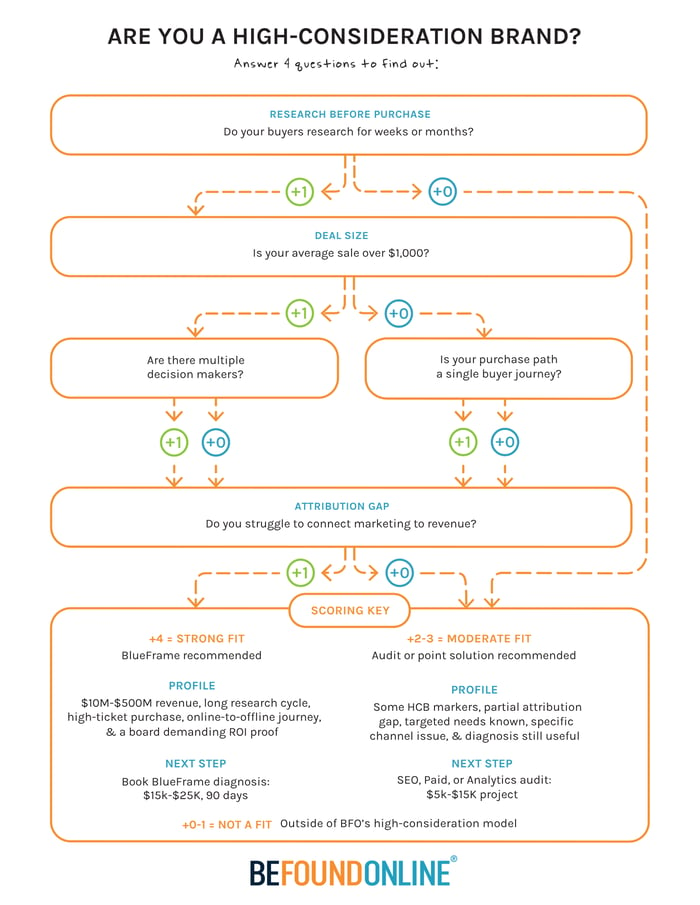
What Defines a High-Consideration Brand
For everyone still nodding along, let’s talk about what a high-consideration brand looks like.
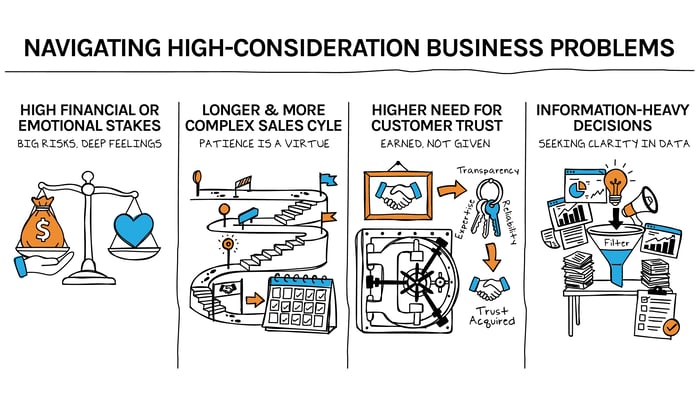
High Financial or Emotional Stakes
These purchases matter a lot to the buyer. They often represent a significant financial commitment or something that will impact day-to-day life for years. Aka, nobody’s winging it.
A Longer, More Complex Sales Cycle
High-consideration journeys are rarely one-and-done.
Buyers research, compare, and loop in stakeholders. They come back three weeks later with new questions. There are multiple touchpoints, and often a human conversation (or several) before anything is finalized.
Trust Isn’t Optional
In high-consideration categories, trust does a lot of the heavy lifting.
Buyers are looking for a partner who seems credible, knowledgeable, and unlikely to disappear the minute the contract is signed.
Brands that win here tend to show up less like pushy sellers and more like well-informed guides.
Information-Heavy Decision Making
High-consideration buyers do their homework thoroughly.
They’re reading reviews and generally trying to reduce risk before they commit. The more complex the decision, the more information they tend to gather along the way.
If most of this sounds familiar, congratulations! You’re officially operating in high-consideration territory. Welcome to the club.
Common Pain Points for High-Consideration Brands
Marketing a high-consideration product is all about helping people feel confident in making a big decision.
And that’s where things get nuanced.
To market effectively in this space, you need a sharp understanding of what your buyers are wrestling with. Strong campaigns don’t just push features. Instead, they reduce uncertainty and risk at every stage of the journey.
Each brand, audience, and even industry will have its own flavor of challenges. But after 15+ years working with high-consideration clients, we tend to see the same pressure points show up again and again.
Here are the big four:
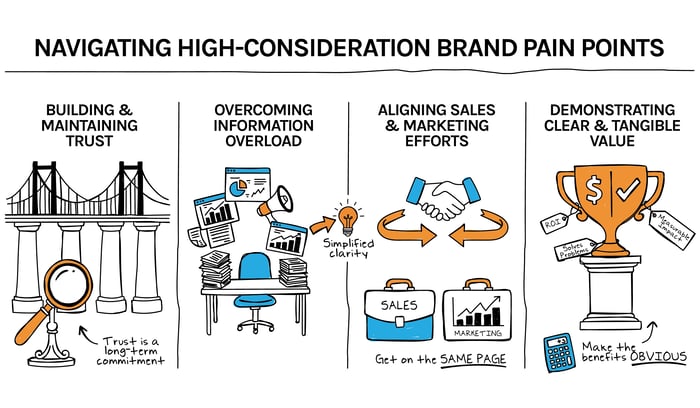
Building and Maintaining Trust
This is the heavyweight champion of high-consideration pain points.
When customers are making a major decision, skepticism is part of the package. They’re actively looking for reasons to believe or reasons to bail.
Without trust, even the best product starts looking like a commodity.
The problem:
The sales journey often involves multiple conversations and touchpoints. Small missteps, like slow follow-ups and inconsistent messaging, can chip away at confidence.
The impact:
Low trust hurts referrals and word-of-mouth, which are disproportionately important in high-consideration categories.
Overcoming Information Overload
High-consideration buyers do a lot of research.
But more research doesn’t always mean more clarity. At a certain point, buyers hit analysis paralysis, with too many tabs open and not enough confidence to move forward.
The problem:
Brands need to provide depth (case studies, testimonials, technical details) without accidentally overwhelming the people they’re trying to help. The goal is to simplify the decision, not add to the noise.
The impact:
Frustrated buyers delay decisions or abandon the process altogether.
Aligning Sales and Marketing Efforts
In high-consideration journeys, marketing doesn’t hand off a neat and tidy conversion. Really, it hands off a conversation already in progress.
When marketing and sales aren’t telling the same story, buyers notice, and it erodes confidence fast.
The problem:
Marketing may generate a lead with one narrative or promise, but if sales isn’t equipped to continue that thread, the experience feels disjointed and harder to trust.
The impact:
Leads stall, handoffs get messy, and the brand starts to feel less coordinated than it is.
Demonstrating Clear, Tangible Value
High-consideration buyers are betting on an outcome.
Which means your value proposition has to feel concrete and defensible.
The problem:
Long-term benefits and complex solutions can be tough to translate into immediate value. When the payoff feels fuzzy, the price tag feels heavier.
The impact:
Buyers gravitate toward cheaper, lower-risk alternatives just because the ROI is easier to understand.
High-consideration marketing works best when it directly addresses these points instead of dancing around them.
Overcome Your Common Pain Points
We’ve talked about where high-consideration brands tend to struggle. Now let’s talk about what helps.
Luckily, none of these challenges require marketing gymnastics. But they do require consistency and a little intentional structure. Below, we’ve mapped practical moves to each of the major friction points.
How to Build and Maintain Trust
When skepticism is high (and in high-consideration categories, it always is), your job is to show up as the calm expert in the room.
Become a Knowledge Hub
Buyers are actively looking for answers, so be the place they find them.
Create helpful, educational content that tackles the complex questions your audience is asking. We’re talking about detailed guides, deep-dive blog posts, webinars, and practical resources.
Bonus: Well-structured content also increases your chances of showing up as a cited source in AI-driven research, which is becoming a bigger part of the early buyer journey.
Show, Don’t Just Tell
Trust grows faster when other people are doing the talking.
Lean into social proof:
- Authentic customer testimonials
- Case studies with quantifiable results
- Awards and credible industry certifications
A strong case study is often one of the most useful assets a high-consideration brand can build.
Cultivate Brand Ambassadors
Your happiest customers are sitting on untapped marketing power.
Encourage clients to leave reviews and advocate on your behalf. Peer validation carries serious weight when the stakes are high and buyers are trying to reduce risk.
How to Overcome Information Overload
When your buyers are researching heavily, your job is to make that process feel manageable instead of overwhelming.
1. Curate the Information
More content isn’t always more helpful.
Create a guided path that moves buyers logically from early education to confident decision-making. Your site structure should build trust step by step, rather than dumping every resource on the table at once.
2. Centralize Your Content
Make the important stuff easy to find.
Pricing, specs, FAQs—all of the essentials should live in organized locations. When buyers have to hunt across multiple pages (or worse, multiple sites), confidence tends to drop.
3. Provide Expert Consultation
Sometimes buyers just want to talk to a human who knows what they’re doing.
Offering consultations with a product expert or knowledgeable sales rep can really speed up decision-making. It helps customers cut through the noise and get answers tailored to their situation.
How to Align Sales and Marketing
In high-consideration journeys, marketing hands sales a warmed-up, well-informed human being. That’s why sales and marketing need to feel like one continuous experience.
Otherwise, they’re just politely waving at each other across a gap.
1. Establish a Lead Qualification Matrix
Get very clear together on what counts as a Marketing Qualified Lead (MQL) and a Sales Qualified Lead (SQL).
When both teams agree on expectations, marketing can focus on attracting the right prospects, and sales can engage with better context and timing.
2. Integrate Your Technology
A shared CRM is table stakes here.
Both teams should have visibility into the full customer journey, from the first site visit to the latest sales conversation. That shared history prevents redundant questions.
3. Unify Your Messaging
Mixed messages create instant friction.
Regular cross-functional check-ins help ensure your positioning and key talking points stay consistent across content and sales conversations.
To the buyer, it should feel like one brand voice the entire way through.
How to Demonstrate Clear and Tangible Value
High-consideration buyers are trying to justify a meaningful investment. So it’s your job to help them connect the dots.
1. Focus on the Outcome
Features matter, but outcomes close deals.
Shift messaging from “what this is” to “what this enables.” Make it painfully clear how your solution solves the buyer’s problem or improves their situation in real terms.
2. Create ROI Calculators
When value is financial, make it visible.
Interactive ROI tools allow prospects to plug in their own numbers and see personalized potential impact. This helps reduce uncertainty fast.
3. Highlight the “Hidden” Value
Not all value shows up in a feature list.
Implementation expertise, ongoing service, and long-term partnership all matter deeply in high-consideration decisions. Make sure those elements are clearly communicated, since they’re often major differentiators.
So, Now What?
At its core, high-consideration marketing is about helping real people feel confident making big decisions.
When you align your teams and make your value easy to understand, momentum starts building. And your marketing starts doing the heavy lifting it was meant to do in the first place.
If you want help tightening your positioning and creating trust-driving content, BFO’s here.
Reach out anytime. We’d love to dig in with you!


SUBSCRIBE TO OUR BLOG
Stay up to date with the latest industry best practices in digital marketing!



















.png?width=339&height=179&name=Webinar%20Banner%20(1).png)


.png?width=339&height=179&name=July%20Webinar%20(Newsletter).png)


.png?width=339&height=179&name=Webinar%20Banner-April-02%20(1).png)
%20(4).png?width=339&height=179&name=Webinar%20Banner-May-02%20(1)%20(4).png)




.png?width=339&height=179&name=March%202023%20Webinar%20Ad%20(autoresponder).png)



.svg)
.svg)
.svg)
%20(1).svg)
.svg)
.svg)

.png?width=339&height=179&name=2025%20Paid%20Media%20(1200%20x%20628%20px).png)
















































.png?width=339&height=179&name=2026%20Paid%20Media%20Ad%20Specs%20(Twitter%20Post).png)

.png?width=339&height=179&name=1%20(3).png)