.png?width=200&height=42&name=%C2%AE%20(200%20x%2042%20px).png)




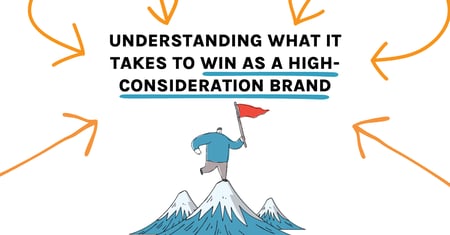
Not every customer journey is built for speed.
While plenty of businesses are chasing quick wins and blink-and-you-miss-it conversions, some brands live in a different reality. Their buyers take their time, ask more questions, and do their homework (sometimes extensively).
Welcome to the world of high-consideration brands.
These aren’t everyday purchases. Instead, they’re decisions that come with real weight—financially, emotionally, or in terms of long-term impact. Think: buying a home, choosing a university, selecting enterprise software, or planning a major renovation. When the stakes are high, so is the need for trust and confidence.

If your business depends more on building relationships than driving quick transactions, understanding how high-consideration buying works is essential for long-term growth.
Is Your Business a High-Consideration Brand?
Not sure where you fall? A few patterns tend to show up in high-consideration categories.
High Stakes Are Involved

The purchase typically carries meaningful weight in at least one of these areas:
Financial: The investment is substantial. We’re talking luxury vehicles, custom homes, enterprise software, or other high-ticket solutions.
Emotional: The decision feels personal and important, often tied to major life moments like higher education, healthcare decisions, or wedding planning.
Long-Term Commitment: The customer is signing up for something that will stick around for a while, like insurance policies, wealth management relationships, or many B2B services.
The Sales Cycle Is Extended
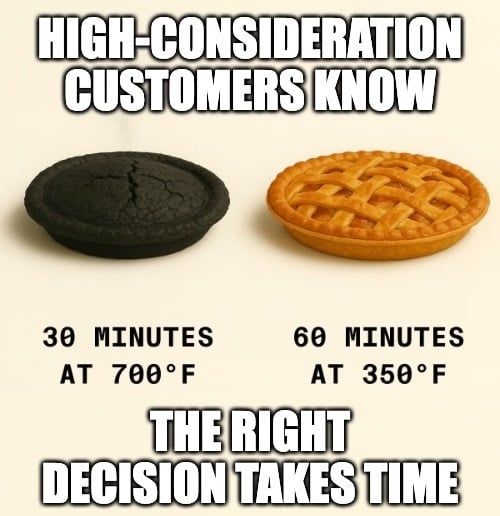
High-consideration decisions rarely happen overnight.
Customers often spend weeks or months researching and weighing their options. In many cases, multiple stakeholders are involved, adding another layer of complexity (and a longer timeline!).
If your deals tend to involve patience and follow-ups rather than same-day conversions, this is a strong signal.
Research Is Deep and Information-Heavy

High-consideration buyers aren’t skimming.
They’re actively looking for detailed information, reviews, and comparisons before they feel comfortable moving forward. That means education and trust-building should be at the top of your to-do list here.
Personalized Engagement Matters

In most high-consideration categories, a one-size-fits-all experience doesn’t cut it.
Buyers often expect:
- Consultations
- Demos
- Personalized quotes
- Direct conversations with knowledgeable humans
The more complex the decision, the more buyers value tailored guidance.
If you found yourself nodding to most of the above, welcome to the club! You’re likely operating in high-consideration territory. And your marketing strategy should be built accordingly.
Common Customer Pain Points for High-Consideration Brands
Making a high-stakes decision isn’t exactly a ~chill~ experience.

Buyers in these categories are trying to avoid expensive mistakes, future headaches, and the awkward feeling of choosing wrong. Understanding where that friction shows up is the first step to kicking it to the curb.
Here are the pressure points we see all the time.
Lack of Trust & Credibility
Skepticism is standard in high-consideration decisions.

When the investment is big (financially or emotionally), buyers worry about picking the wrong partner, wasting budget, or ending up locked into something that doesn’t deliver. Until trust is firmly in place, momentum tends to stall.
Brands that struggle here often see plenty of interest, followed by hesitation that’s hard to diagnose.
Information Overload & Analysis Paralysis
High-consideration buyers want details, but there is absolutely a tipping point.

Too many tabs, PDFs, and conflicting opinions can make confidence drop fast. Instead of feeling informed, buyers start feeling stuck.
The challenge is helping customers understand what matters and what they can safely ignore.
Misaligned Expectations
Few things erode confidence faster than mixed signals.

It goes like this: Marketing sets one expectation, sales tells a slightly different story, then the offer itself isn’t even close to either one’s promises. Buyers notice, and trust takes a hit.
In high-consideration journeys, consistency is the ultimate stability signal.
Difficulty Quantifying Value
When the investment is significant or the solution is complex, buyers struggle to connect cost to outcome.

They may understand the features, and they may even like the brand. But if the real-world impact feels fuzzy, the decision feels riskier than it should.
Strong high-consideration brands don’t drone on and on about the fine print. Instead, they make the long-term value easy to see.
The clearer and calmer your experience feels, the easier it becomes for buyers to hit the gas.
How to Solve These Pain Points
High-consideration friction doesn’t disappear on its own. It takes a thoughtful mix of empathy and education to move buyers forward.
Fortunately, the playbook is pretty clear once you know where to focus.
Build and Maintain Trust Through Transparency & Expertise
Trust is the unlock in high-consideration marketing. Everything else works better once this is in place.

Become a Trusted Resource
If buyers are doing deep research (spoiler: they are), your brand should help them do it well.
Invest in genuinely useful, educational content that answers questions and demonstrates real expertise. Detailed guides, webinars, and expert-led blog content all pull their weight here.
Leverage Social Proof Extensively
In high-stakes decisions, buyers want receipts.
Bring forward:
- Authentic customer testimonials
- In-depth case studies with measurable results
- Industry awards and certifications
- Credible third-party validation
Real-world proof tends to carry more weight than even the most polished brand copy.
Foster Long-Term Relationships
High-consideration buyers want a partner they can trust.
Make space for open communication and offer personalized consultations. Bonus: Post-sale experience tends to generate more referrals.
Guide Through Information Overload with Clarity
Your buyers want information, of course. They just don’t want to drown in it.

Curate the Journey
Instead of handing over a content firehose, guide people to what matters most for their situation.
Interactive tools like quizzes, configurators, and decision trees can help customers zero in on the best paths forward.
Centralize and Simplify
Make the important information easy to find and understand.
Pricing, specs, FAQs, case studies. All of these should live in well-organized locations on your site. Clear language and strong visuals go a long way in making big ideas feel manageable.
Offer Direct Access to Expertise
Sometimes buyers just need to talk it through.
Create clear pathways for people to connect with sales reps who can help them out and answer questions. The faster you help them cut through the noise, the faster confidence builds.
Ensure Seamless Alignment Between Sales and Marketing
In high-consideration journeys, marketing hands off an informed human, not a finished deal.

That’s why your teams need to feel like one continuous experience.
Unified Messaging
Regular check-ins help marketing and sales speak the same language (literally).
Marketing should feed real buyer insights to sales, and sales feedback should shape marketing strategy in return. This alignment should be as consistent as Chicago traffic at rush hour.
Integrated Technology (CRM)
A shared CRM gives both teams the same playbook to work from.
When everyone can see the full customer journey, you cut down on repeat questions and make the whole experience feel more seamless for the buyer.
Shared Goals and KPIs
Things tend to click faster when marketing and sales are measured against the same customer outcomes.
Connect marketing and sales goals across the full journey (lead quality, conversion, pipeline health, and long-term retention) so everyone is pulling in the same direction.
Clearly Demonstrate Tangible and Emotional Value
High-consideration buyers are trying to justify a meaningful decision. It’s your job to help them connect the dots.

Focus on Outcomes, Not Just Features
Features describe, but outcomes persuade.
Frame your messaging around the real-world impact your solution creates. What problem gets solved? What improves? What future becomes possible because of your offer?
Make the value easy to picture.
Provide Personalized ROI Tools
For high-ticket or B2B offerings, specificity builds confidence fast.
Interactive ROI calculators that let prospects enter their own data can make the potential return feel concrete rather than theoretical.
Highlight the Intangibles
Not all value shows up neatly on a spreadsheet.
Things like…
- Peace of mind
- Reliability
- Prestige
- Security
- Convenience
- Long-term partnership
These emotional drivers often play a massive role in high-consideration decisions.
Make sure you’re communicating both the rational and emotional sides of the value equation.
Suggested Marketing Techniques for Success
High-consideration buyers don’t rush, and your marketing shouldn’t either.
The most effective strategies mirror the way these customers make decisions: thoughtfully, in stages, and with a healthy appetite for detail. When your marketing meets them where they are (instead of trying to speed them up), everything tends to work better.
Here’s where to focus.
Content Marketing, Elevated
Surface-level content never really moves high-consideration buyers. Depth wins here.

In-Depth Guides & Ebooks
This is your cue to go beyond basic 500-word blogs.
Create comprehensive resources that walk through the full decision process. Answer the questions and explain the “what happens if…” moments your buyers are thinking about. The more complete the resource, the more credibility it builds.
Webinars & Workshops
Sometimes buyers want to hear from someone who knows their stuff.
Live or on-demand webinars give your experts a chance to educate and answer questions in real time. Plus, they’re also excellent trust-builders when done well.
Case Studies & Success Stories
These are still one of the best assets in high-consideration marketing.
Strong case studies clearly show:
- The customer’s starting challenge
- How your solution was implemented
- The measurable results that followed
It’s not bragging if you can prove it.
SEO & Thought Leadership
High-consideration buyers do serious research. So you want to be findable when they do.
Target Long-Tail Keywords
Broad terms get attention. But specific questions drive qualified traffic.
Focus on the detailed queries your audience is searching during the research phase, such as “best for” and “what should I consider” types of searches.
Establish Authority
Consistency compounds.
Regularly publishing high-quality content around complex topics helps reinforce your position as a credible voice. Over time, this builds the kind of authority that both search engines and buyers love to see.
Personalized Email Nurturing Campaigns
Not every prospect is ready to talk to sales, but a handful are open to learning more.

Segment Your Audience
Different stages of the journey call for different conversations.
Use behavioral and lifecycle signals to tailor email content so it meets prospects where they are, instead of sending the same message to everyone.
Educational Drip Campaigns
Think of nurture as guided confidence-building.
Deliver useful information that helps prospects move forward without feeling overwhelmed. Early on, resist the urge to push too hard on the sale. Trust tends to build faster when education leads.
Interactive Tools & Visualizations
Complex decisions get easier when buyers can see the value.
Consider tools like:
- Online configurators that let customers customize options and see outcomes in real time
- ROI calculators that make financial impact tangible
- Virtual tours or AR experiences that bring physical products or spaces to life
Remarketing & Retargeting
High-consideration journeys can take a whole lot of visits to complete.

Sustain Awareness
Stay visible to prospects who have already engaged but aren’t ready to convert. Consistent, thoughtful remarketing helps keep you top of mind during longer decision cycles.
Tailor the Message
Generic retargeting only goes so far.
Serve ads that reflect what the user viewed or engaged with. You’ll want to reinforce the specific value propositions that matter most to them at that moment.
Building Community & Social Engagement
Trust often grows faster in environments that feel conversational.

Online Forums & Groups
Creating spaces where prospects and customers can ask questions, share experiences, and learn from each other can be incredibly powerful in high-consideration categories.
A little peer validation still carries serious weight.
LinkedIn for B2B
For B2B brands especially, LinkedIn remains a high-impact channel for:
- Thought leadership
- Expert visibility
- Direct engagement with decision-makers
Used well, it supports authority-building and pipeline growth.
Putting This Into Practice
High-consideration buyers were never going to be the “add to cart and vibe” crowd.
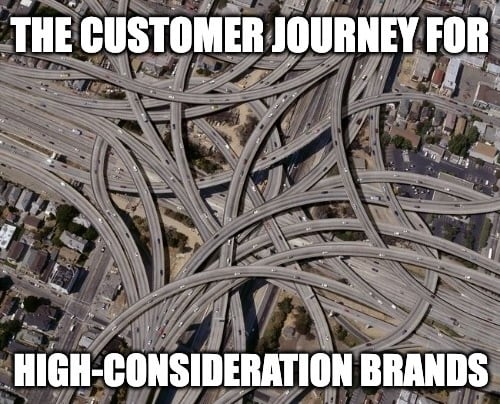
These are the spreadsheet people and the comparison-tab collectors. That’s why the brands that win here don’t shout the loudest. They make the decision feel clearer and a lot less risky.
Feeling like your current strategy could be doing a bit more of that heavy lifting? You’re in good company.
Whenever you’re ready to tighten the approach or make your high-consideration funnel work smarter, BFO’s here to help.


SUBSCRIBE TO OUR BLOG
Stay up to date with the latest industry best practices in digital marketing!



















.png?width=339&height=179&name=Webinar%20Banner%20(1).png)

.png?width=339&height=179&name=July%20Webinar%20(Newsletter).png)


.png?width=339&height=179&name=Webinar%20Banner-April-02%20(1).png)
%20(4).png?width=339&height=179&name=Webinar%20Banner-May-02%20(1)%20(4).png)




.png?width=339&height=179&name=March%202023%20Webinar%20Ad%20(autoresponder).png)



.svg)
.svg)
.svg)
%20(1).svg)
.svg)
.svg)

.png?width=339&height=179&name=2025%20Paid%20Media%20(1200%20x%20628%20px).png)



















































.png?width=339&height=179&name=2026%20Paid%20Media%20Ad%20Specs%20(Twitter%20Post).png)

.png?width=339&height=179&name=1%20(3).png)