.png?width=200&height=42&name=%C2%AE%20(200%20x%2042%20px).png)




Google rolled out its latest spam update this month, and this one appears to have made more noise than your average spam update.
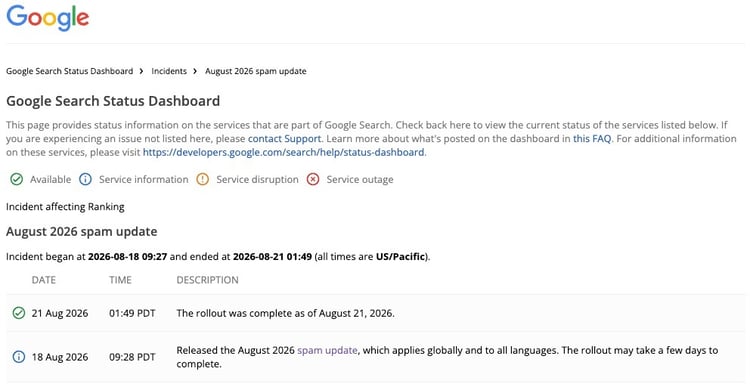
The August 2026 Spam Update began on August 18 and finished on August 21, completing in just under three days. The update was global, applied across all languages, and was the third confirmed spam update from Google this year.
Google did not announce a new spam policy or tell us exactly what the update targeted. But now that the rollout is complete, ranking data and early industry analysis are giving us a better idea of what may have changed and what businesses should be paying attention to.
August 2026 Spam Update Breakdown
Here’s what we know:
- Started: August 18, 2026
- Completed: August 21, 2026
- Scope: Global and across all languages
- Previous spam updates: March and June 2026
Google regularly updates its automated spam detection systems, including SpamBrain, but announces updates when it makes larger changes that could noticeably affect search performance.
If that sounds familiar, it should. We covered similar changes in our previous articles on the March 2026 Google Spam and Core Updates and August 2025 Spam Update.
This Updated Created More Ranking Volatility Than Usual
While Google called this a normal spam update, the impact on search results wasn't necessarily normal.
According to ranking data reported by Search Engine Land, SE Ranking found significant movement during the rollout. Of the URLs ranking in the top 10 before the update, 16.71% dropped outside the top 100 for the same keyword. During a comparable period without a confirmed Google update, that number was 9.2%.
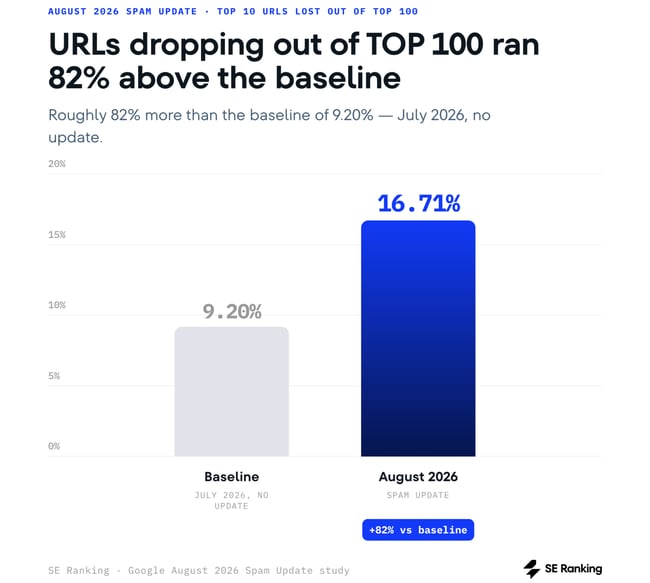
That's a meaningful difference and shows that this update created considerably more disruption than Google's normal day-to-day ranking changes.
That doesn't mean every website that lost rankings violated Google's spam policies. Algorithm updates can create movement for many reasons, so a decline shouldn't automatically lead to major changes to your SEO strategy.
Instead, look at where the losses occurred. If declines are concentrated within a particular section of your website, content type, or group of keywords, that can help determine whether the update exposed a larger issue.
Did Google Target AI-Generated SEO Content?
One of the bigger conversations coming out of the August update is whether Google is getting more aggressive about AI-generated content.
Search Engine Journal reported examples of websites publishing large amounts of automated and AI-generated content losing visibility during the update. However, Google has not confirmed that this update specifically targeted AI content.
For businesses using AI to support content creation, that's an important distinction.
Using AI isn't inherently the problem. The risk comes when it's used to publish large amounts of generic, repetitive, or low-value content primarily to rank in search.
Our recommendation isn't to avoid AI. Use it to make your content process more efficient, but keep human expertise, fact-checking, editing, and original insights involved. Ultimately, your content still needs to provide something useful that your audience can't get from hundreds of similar pages already competing in search.
What Does This Mean for AI SEO and AI Visibility?
There is another side to this conversation that goes beyond traditional Google rankings.
Google has clarified that its spam policies also apply to attempts to manipulate its generative AI search experiences, including AI Overviews and AI Mode.
That makes the connection between traditional SEO and AI visibility increasingly important. Content created primarily to manipulate search at scale could create problems beyond traditional rankings.
For brands investing in AI SEO, the takeaway isn't to produce more content for AI. It's to create content that gives search engines and AI platforms a reason to trust and reference your brand.
Original expertise, credible sourcing, unique data, first-hand experience, clear answers, strong topical coverage, and trustworthy brand signals all become more important as brands compete for both traditional rankings and AI visibility.
What Should You Do If Your Rankings Dropped?
Now that the rollout is complete, businesses have a cleaner window to evaluate performance.
Start by comparing Google Search Console and analytics performance before August 18 with performance after August 21. Rather than looking only at total organic traffic, identify which pages, queries, directories, and content types experienced the biggest changes.
If you find meaningful declines, review:
- Whether you have large amounts of thin, repetitive, or search-first content
- How AI is being used within your content production process
- Whether your pages genuinely add something useful compared with what's already ranking
- Your backlink profile and any questionable or manipulative link-building practices
- Other areas covered by Google's spam policies
Most importantly, don't panic and start rewriting or deleting content based on a few days of data. Identify patterns first and determine whether the decline can reasonably be connected to the update.
Recovery can also take time. Cleaning up an issue today doesn't mean rankings will return tomorrow. Google's automated systems need time to reassess a website and recognize longer-term changes.
What This Means for You
The August update is another reminder that publishing more content isn't the same as having a better content strategy.
AI has made content faster and cheaper to produce, but that also makes it easier to publish pages that answer a question without adding much value. The opportunity is to use AI to make marketing teams more efficient without replacing the experience, expertise, authoritativeness, and trustworthiness (EEAT) that make content worth reading.
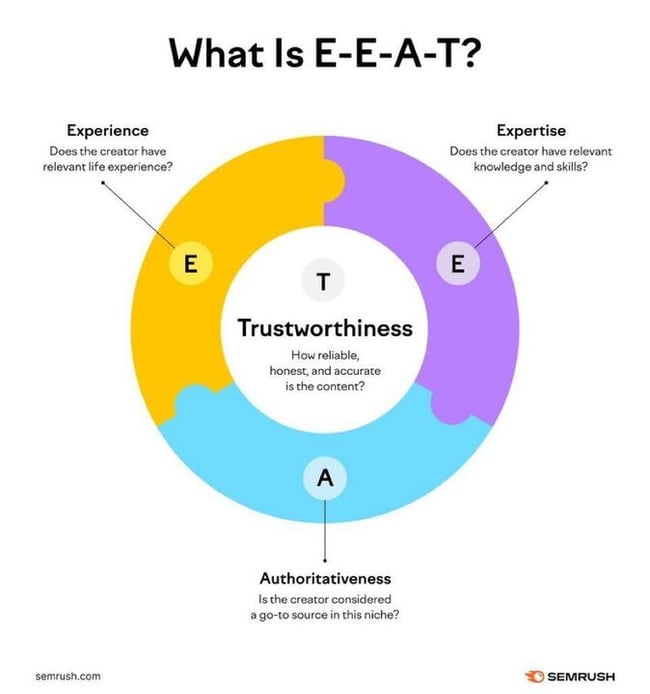
Focus on creating content your audience actually needs and use AI where it improves the process. That’s a stronger foundation for both traditional rankings and visibility across AI-driven search.
If your organic visibility changed following the August update, Be Found Online can help identify what changed, whether it’s normal volatility or a broader content or site-quality issue, and where to focus next.


SUBSCRIBE TO OUR BLOG
Stay up to date with the latest industry best practices in digital marketing!













.png?width=339&height=179&name=Webinar%20Banner%20(1).png)


.png?width=339&height=179&name=July%20Webinar%20(Newsletter).png)
.png?width=339&height=179&name=Webinar%20Banner-April-02%20(1).png)
%20(4).png?width=339&height=179&name=Webinar%20Banner-May-02%20(1)%20(4).png)




.png?width=339&height=179&name=March%202023%20Webinar%20Ad%20(autoresponder).png)


.svg)
.svg)
.svg)
%20(1).svg)
.svg)
.svg)
.png?width=339&height=179&name=2025%20Paid%20Media%20(1200%20x%20628%20px).png)




































.png?width=339&height=179&name=2026%20Paid%20Media%20Ad%20Specs%20(Twitter%20Post).png)

.png?width=339&height=179&name=1%20(3).png)