.png?width=200&height=42&name=%C2%AE%20(200%20x%2042%20px).png)




Quick quiz: do you know how your brand shows up when someone asks ChatGPT about your category?
If the answer is "not really" or "I've never checked," you're in good company. Most brands diligently track their Google rankings, monitor traffic, and optimize pages…while having absolutely no idea what AI is telling their buyers about them before they land on a website.

And AI is telling them things daily. More and more people use it as their first stop in the research process, rather than opening Google and clicking through a list of links.
The brands showing up in those answers have a head start that's tough to see in a traditional analytics dashboard. The ones that aren't showing up? They're usually the last to know.
Luckily, checking your AI presence is more straightforward than it sounds. Most of it is free, none of it requires a computer science degree, and you can do it all before your next meeting. Here's what you can do.
Start With the Obvious
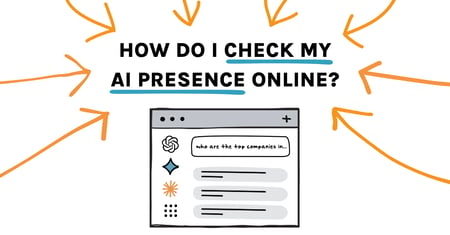
This one sounds almost too simple, but it's the best place to start: open up ChatGPT, Perplexity, or Gemini and start asking the questions your buyers are asking. You want the ones someone types when they're trying to figure out what to buy or who to work with.
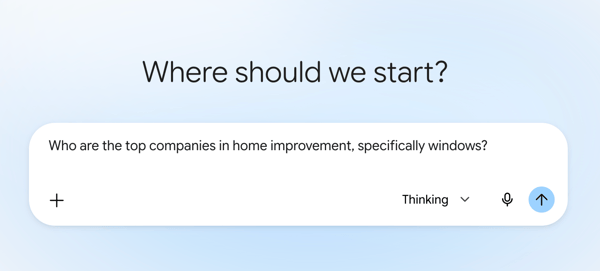
Try something like:
- "Who are the top companies in [your category]?"
- "Who are the top providers of [problem you solve]?"
- "What are the best alternatives to [competitor name]?"
- "What is [your brand] known for?"
Then pay attention to what comes back. Are you mentioned at all? How are you described when you are? Who shows up in the spots you're not?
This is AI giving you an unfiltered, unsponsored, honest picture of how it currently understands your brand.
For some businesses, that's a pleasant surprise. For others, it's humbling. Either way, it's information worth having before you assume you know how you're showing up.
Run the prompts, take notes, and if a competitor keeps appearing in spots where you expected to see yourself, that's a signal worth paying attention to.
Use Google Search as an AI Proxy
Fun(ish) fact: Even when AI Overviews aren't showing up in your search results, Google is still giving you a window into how AI systems perceive your brand.
AI doesn't form its opinions in a vacuum. It leans heavily on review sites, comparison articles, list-based content, FAQs, and explainers, aka the kinds of pages that tend to rank well in traditional search. That means if your brand isn't showing up in those result types, AI has much less to work with when someone asks about your category.
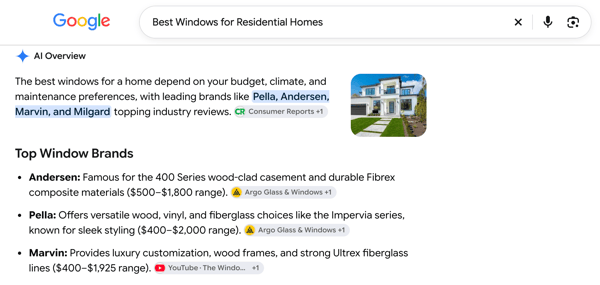
So pull up Google and run a few searches:
- Your brand name + reviews
- Your brand name + best
- Your brand name + vs
- Your brand name + alternative
- Best [category] for [use case]
What you're looking for is whether your brand is showing up in the places AI trusts. Are you appearing in comparison articles? Review roundups? Industry lists? Or are those spots filled with competitors?
A healthy external presence looks like your brand being mentioned, compared, reviewed, and discussed in places you didn't create and don't control. A thin one looks like your website ranking for your own name and not much else.
Google is showing you the raw material AI is working from. If that material is sparse, that's the gap worth closing first.
Check What People Are Saying About You Off Your Website
Your website is only one piece of the picture AI is working from. Everything else, like the reviews, Reddit threads, LinkedIn mentions, and industry blog posts, is part of it too. In a lot of cases, that outside conversation carries more weight than anything on your site.
AI cares about mentions as much as it cares about links. An unlinked reference to your brand in a credible third-party source is a signal that helps AI understand what you do, who you serve, and whether you're worth bringing up when someone asks a question.

Checking this takes about five minutes. Try these:
- Google your brand name with -site:yourdomain.com added to the search. This removes your own website from the results and shows you everywhere else your brand is being talked about.
- Search your brand name manually on Reddit, Quora, LinkedIn, and any industry publications your buyers read.
What you're looking for is whether people are talking about your brand, whether you're showing up alongside competitors in relevant conversations, and whether third-party sites are accurately explaining what you do.
If the results are thin (or worse, if what's out there is outdated or slightly off), that's the gap AI is working around, and it's one of the most fixable problems in the whole AI visibility picture.
The Four Pillars AI Is Evaluating
Running the checks above gives you a surface-level read on your AI presence. But to understand why some brands get cited consistently and others don't, it helps to know what AI evaluates under the hood.
Technical Foundation
AI systems rely on structured, crawlable, accessible websites. If search engines struggle to interpret your site, AI models will too. Clean HTML structure, proper canonicalization, schema markup, fast mobile-friendly performance—the unglamorous technical stuff is the foundation everything else sits on. A technically messy site is one AI has a hard time reading, regardless of how good the content is. More on Technical SEO here.
.svg)
Content and Topical Authority
AI doesn't just match keywords. It synthesizes trusted sources and looks for brands that demonstrate expertise across a topic area. This isn’t a blog post here and there, but consistent, well-organized coverage that signals you know what you're talking about. Depth over volume, every time. More on SEO Content here.
.svg)
On-Page Clarity
AI extracts meaning from structure. Content that's logically organized and easy to navigate (think: defined headers, consistent terminology, and author attribution) is content AI can understand and reuse. If your pages are hard for a human to scan, they're probably hard for AI to parse too. More on On-Page SEO here.
.svg)
Off-Page Authority
This is where many brands have the biggest gap. AI reflects the broader web consensus, not just what lives on your website. High-quality backlinks, brand mentions on trusted sites, reviews, expert contributions, and consistent messaging across platforms all feed the signal. A brand that only exists loudly on its own website is essentially vouching for itself with no outside confirmation, and AI is skeptical of that in the same way a cautious buyer would be. More on Off-Page SEO here.
Tools Worth Checking Out
Because we've been doing this for a while, we've put together some Be Found Online Tools to help get you started:
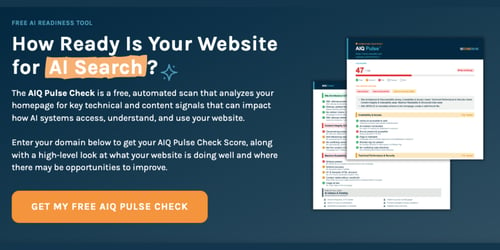
AIQ Pulse Check
The AIQ Pulse Check from Be Found Online is a free, automated scan that analyzes your homepage for key technical and content signals that can impact how AI systems access, understand, and use your website.
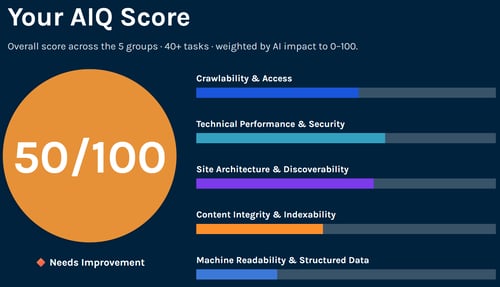
AIQ Score
The AIQ Score by Be Found Online is a proprietary AI visibility assessment of your website's AI readiness and AI visibility. AIQ measures how well Google, ChatGPT, and other popular LLMs can find, read, trust, and cite your brand.
So You Checked. Now What?
Running these checks is a good use of thirty minutes. However, the tricky part is knowing what to do with what you find.
Because discovering that you're not showing up in AI answers is useful info. Understanding why, knowing which of the four pillars needs the most attention, and building a presence that holds up consistently across ChatGPT, Perplexity, Google AI Overviews, and wherever search goes next is where it gets more involved.
That's what the Be Found Online AIQ Score is built for. It's a comprehensive analysis of how your brand and website perform across AI-powered search environments.
So if you've run the checks above and you're ready to go deeper than a Google search and a notepad, an AIQ report is your best next step!



SUBSCRIBE TO OUR BLOG
Stay up to date with the latest industry best practices in digital marketing!








.png?width=339&height=179&name=Webinar%20Banner%20(1).png)
.png?width=339&height=179&name=July%20Webinar%20(Newsletter).png)
.png?width=339&height=179&name=Webinar%20Banner-April-02%20(1).png)
%20(4).png?width=339&height=179&name=Webinar%20Banner-May-02%20(1)%20(4).png)

.png?width=339&height=179&name=March%202023%20Webinar%20Ad%20(autoresponder).png)

.svg)
.svg)
.svg)
%20(1).svg)
.svg)
.svg)

.png?width=339&height=179&name=2025%20Paid%20Media%20(1200%20x%20628%20px).png)





























.png?width=339&height=179&name=2026%20Paid%20Media%20Ad%20Specs%20(Twitter%20Post).png)

.png?width=339&height=179&name=1%20(3).png)