.png?width=200&height=42&name=%C2%AE%20(200%20x%2042%20px).png)




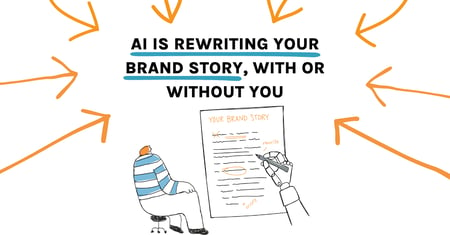
Somewhere right now, a potential customer is asking AI about your brand. AI, occasionally wrong, yet always confident, is giving them an answer.
You weren’t consulted, and your marketing team wasn’t looped in. It just...answered.
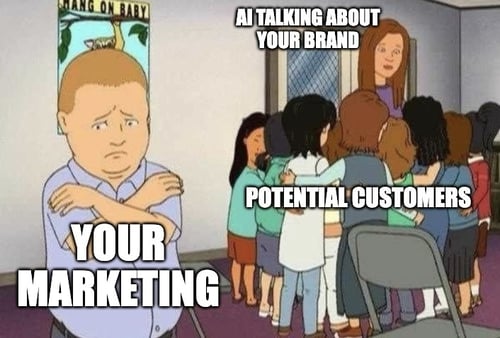
This is the part where we're not going to tell you to panic, because panic is not a strategy. However, we are going to tell you that the version of your brand living inside AI answers might not be the one you'd write yourself, and that's worth knowing about.
For a long time, brands had a decent amount of control over their own story. You owned the channels, wrote the messaging, and decided what went out into the world. AI has added a new voice to that conversation, and it didn't ask for permission.
Luckily, you’ve got more influence over what it says than you might think. Here's how it all works.
How AI Builds a Picture of Your Brand
Reminder: AI isn't reading your website the way a potential customer does (we hope that’s obvious, since AI is not a living, breathing human…but stick with us).
It's not absorbing your carefully chosen words and faithfully repeating them back to people. It's doing something messier than that.
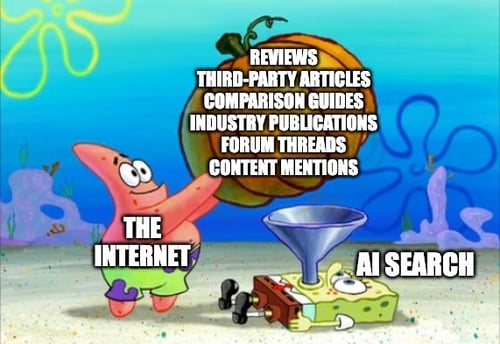
Really, it's pulling from an enormous range of sources...
- Reviews
- Third-party articles
- Comparison guides
- Industry publications
- Forum threads
- Content from people who have used you, written about you, or compared you to someone else
and building a picture of your brand from all of it at once.
Which means your brand story, as far as AI is concerned, is the sum of everything that's ever been said about you. Not only the stuff you said.
When those sources are consistent and credible, AI can get it right. When they're thin, scattered, or contradictory, AI doesn't throw up its hands and admit it's confused. It picks the loudest, most repeated signal and runs with it.
Unfortunately, that signal might not be the version of your brand you'd choose.
The Brands Getting Described Accurately + Why
So what do the brands that AI gets right have in common?
They're not doing anything particularly cutting-edge. They've just built a presence that's hard to misread.
For starters, their story is specific. They’re not trying to appeal to everyone. That kind of clarity travels well. When the same core idea keeps showing up across a brand's website, reviews, press mentions, and third-party comparisons, AI has an easy job.
The other thing these brands have in common is that they exist loudly outside of their own channels. They're showing up in industry publications and being mentioned in conversations they didn't start. That outside validation is what gives AI something to trust beyond the brand's own word for it.
The brands that are easiest for people to understand tend to be the easiest for AI to describe accurately.
The Brands Getting It Wrong + Why
On the flip side, the brands that AI gets wrong tend to have things in common too, and most of them are fixable once you know what to look for.
Vague positioning
If your brand story could belong to a dozen other companies, AI is going to have a hard time telling you apart from them. Positioning that sounds like "we help businesses grow through innovative solutions" gives AI nothing to work with. So it lumps you in with whoever else is saying the same thing.
Conflicting signals across channels
Your website says one thing, yet that profile on an industry directory hasn't been updated since 2021. AI isn't going to sort through those conflicts and figure out which version is right. It's going to pick the one that shows up the most, which may or may not be the one you'd prefer.
Outdated information that never got cleaned up
Old messaging has a surprisingly long shelf life on the internet. If your brand went through a refresh and the old version is still floating around somewhere, AI might still be working from that version.
Only existing on your own platforms
A brand that shows up everywhere on its own website and basically nowhere else is essentially vouching for itself with no outside confirmation. AI is skeptical of that, in the same way a buyer would be. Without third-party reinforcement, the story feels thin.
When any of these are in play, AI fills in the blanks with whatever it has (which might not be so awesome).
How to Take Back Some Control
So this section isn’t a list of tricks to game AI into saying nice things about you. That's not how it works, and anyone telling you otherwise is selling something.
What you can do is give AI better material to work with:
Get clear on your core story
If you can't describe what your brand does and who it's for in two sentences, that's the first thing to fix. Not because it's a fun exercise, but because everything else depends on it. Once you have it, use it everywhere. The goal is for anyone who encounters your brand to walk away with the same impression.
Actively shape the third-party narrative
Encourage reviews, get quoted, and get into the conversations your buyers are having. Every credible outside mention is another signal reinforcing your story, and those signals are what AI leans on.
Audit what AI is saying about you
Go ask. Seriously. Open ChatGPT, ask about your brand, and see what comes back. You might be pleasantly surprised, or you might find something worth fixing. Either way, you should know.
Fix the gaps
Something is off somewhere if what AI says doesn't match what you'd say. Maybe it's outdated information still floating around online or a review profile that hasn't been touched in years. Find the disconnect and close it.
Create content that answers questions
AI gets asked a lot of questions about your category. Content that directly answers those questions, honestly and in plain language, is the material AI is looking for. Write for the questions your buyers are asking instead of the ones that sound good in a headline.
The Unsexy Truth About AI Visibility
Bottom line: the brands that AI gets right are the ones that sound like themselves everywhere.
And that's harder than it sounds.
Think about all the places your brand story lives:
- Your website
- Your sales conversations
- Your email templates
- Your customer support interactions
- Your social profiles
- Your third-party listings
Each one of those is a data point. When they don’t tell the same story, AI starts making judgment calls you probably won't love.
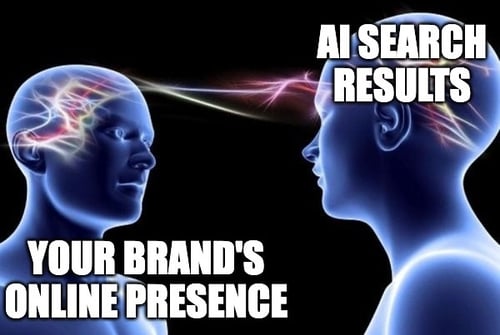
Marketing, sales, and customer experience all feed the story AI builds about your brand. Which means consistency is now an AI visibility issue, and it's more important than it's ever been.
You Can't Control It, But You Can Influence It
There’s a big difference between a brand that shows up in AI answers accurately, and one that shows up as a vague afterthought or doesn't show up at all. That difference is within your control.
Notable brands make sure the raw material AI is working from is accurate, consistent, and strong enough to speak for itself. When it is, AI stops being something to worry about and starts being something that works in your favor.
That's a pretty good place to be. So if you want help getting there, BFO is ready to dig in!


SUBSCRIBE TO OUR BLOG
Stay up to date with the latest industry best practices in digital marketing!













.png?width=339&height=179&name=Webinar%20Banner%20(1).png)

.png?width=339&height=179&name=July%20Webinar%20(Newsletter).png)
.png?width=339&height=179&name=Webinar%20Banner-April-02%20(1).png)
%20(4).png?width=339&height=179&name=Webinar%20Banner-May-02%20(1)%20(4).png)




.png?width=339&height=179&name=March%202023%20Webinar%20Ad%20(autoresponder).png)



.svg)
.svg)
.svg)
%20(1).svg)
.svg)
.svg)
.png?width=339&height=179&name=2025%20Paid%20Media%20(1200%20x%20628%20px).png)





































.png?width=339&height=179&name=2026%20Paid%20Media%20Ad%20Specs%20(Twitter%20Post).png)

.png?width=339&height=179&name=1%20(3).png)