.png?width=200&height=42&name=%C2%AE%20(200%20x%2042%20px).png)




Here we go again.
Just over a month after Google rolled out its August Spam Update, another spam update is officially underway.
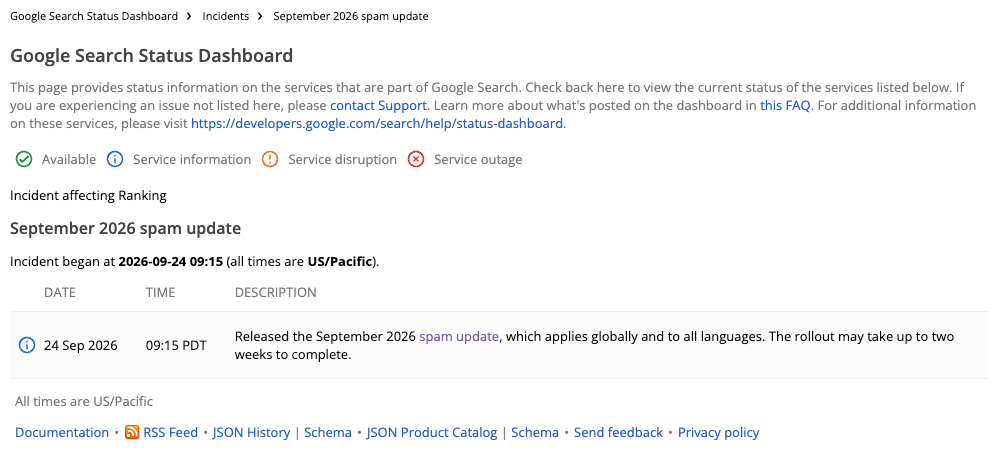
The September 2026 Spam Update began rolling out on September 24 and applies globally across all languages. This time, Google says the rollout could take up to two weeks to complete, which is noticeably longer than the spam updates we’ve seen so far this year.
For businesses, there’s no reason to make changes based on one day of ranking movement. But with four spam updates now released in 2026, there is a bigger trend worth paying attention to.
Key Highlights
- Google launched the September 2026 Spam Update on September 24
- The update applies globally and across all languages
- Google says the rollout could take up to two weeks
- This is the fourth spam update of 2026
- Google has not identified a specific spam tactic being targeted
- The update comes only about a month after the August 2026 Spam Update
- Businesses should monitor organic performance during the rollout, but avoid reacting to short-term ranking fluctuations
What We Know About the September Spam Update
According to the Google Search Status Dashboard, the September Spam Update officially began on September 24 at 9:15 a.m. PDT.
Google hasn't provided much additional detail. It described this as a normal spam update and confirmed that it applies to all languages and locations.
What stands out is the expected timeline.
Google's three previous spam updates this year were relatively quick. March finished in less than a day, while the June and August updates each took a little more than two days. September could take up to two weeks.
Google's John Mueller also confirmed that the longer timeframe wasn't a mistake, according to Search Engine Roundtable.
That doesn't necessarily mean this update will be larger or more impactful. It simply means we may have a longer period of ranking movement before we can properly evaluate the results.
Four Spam Updates in 2026. What's Going On?
The frequency is probably more interesting than any individual update at this point.
Google has released spam updates in March, June, August, and now September.
We covered the first of those alongside the March 2026 Core Update, and just last month broke down the ranking volatility and AI content conversation surrounding the August 2026 Spam Update.
Google's spam detection systems are always running in the background. Spam updates represent more notable improvements to those systems.
The increase in announced updates doesn't necessarily mean Google suddenly has a bigger spam problem. What it does tell us is that Google continues to actively refine how it identifies and handles attempts to manipulate search results.
For businesses, that's another reason to evaluate SEO strategies based on long-term value rather than whether a tactic happens to work today.
What Is Google Targeting This Time?
We don't know yet, and that's important.
Google hasn't announced a new spam policy or said that the September update is focused on one particular tactic.
Its existing Google Search spam policies cover a wide range of practices, including scaled content abuse, cloaking, expired domain abuse, site reputation abuse, hidden text, misleading functionality, and other attempts to manipulate rankings.
We've been following this direction for a while. Back in 2024, we covered Google's expanded spam policies as part of our look at the March 2024 Core Update and spam changes.
For now, we wouldn't try to reverse engineer the September update or assume that one particular SEO tactic is suddenly being targeted.
We'll know more once the rollout progresses and there's enough data to separate actual patterns from normal ranking fluctuations.
What Should Businesses Be Watching?
This isn't the time to watch one keyword jump three positions and start rewriting pages.
Instead, use the rollout period to establish a baseline and look for broader patterns.
Pay attention to:
- Organic clicks and impressions in Google Search Console
- Meaningful changes across groups of keywords rather than individual rankings
- Specific sections or content types gaining or losing visibility
- Changes to organic conversions and leads
- Whether performance changes begin during the confirmed rollout window
If your organic traffic moves 5% one day and returns the next, that's probably not enough information to act on.
If an entire section of your website begins consistently losing rankings, impressions, and traffic, that's worth investigating.
Google recommends that sites affected by spam updates review its spam policies. Google also notes that recovery isn't necessarily immediate. Its systems may need time to recognize that a site has returned to compliance.
Does This Change Anything About AI Content?
Not yet.
AI-generated content became a major part of the conversation after the August Spam Update when industry reports showed examples of heavily automated sites losing visibility.
But Google never confirmed that August specifically targeted AI content, and there is currently no indication that September is an AI content update either.
The distinction we made after August still applies.
AI can be part of a responsible content process. The risk is using AI, or any other production method, to create large amounts of generic content primarily for the purpose of capturing search traffic.

Google's concern is ultimately the outcome, not whether someone opened an AI tool while creating the page.
For businesses, that means AI can still help with research, ideation, outlines, optimization, and content production. Human expertise, editorial review, fact-checking, original insights, and a clear reason for creating the content still need to be part of the process.
SEO and AI Visibility Are Becoming Part of the Same Conversation
Spam updates are also worth watching beyond traditional organic rankings.
Google's policies increasingly span both traditional search results and its AI-powered search experiences. If Google doesn't trust a site or its content enough to surface it in traditional search, that can also limit the opportunities for that brand to appear across AI-driven discovery.
That doesn't mean there's a separate checklist for "AI SEO."
The fundamentals overlap considerably: create useful content, demonstrate real expertise, provide clear answers, build authority around the topics that matter to your business, and make it easy for search engines and AI systems to understand who you are and why your information is credible.
The goal isn't simply to produce more content. It's to become a source worth surfacing.
What We're Watching Next
Four spam updates in nine months shows that spam enforcement continues to be a priority for Google, but that doesn't mean businesses need to change their SEO strategy after every update.
The focus remains the same: create useful content, avoid shortcuts designed to manipulate rankings, and use AI to support your process without sacrificing expertise or quality. We've been following this trend since the August 2025 Spam Update, and it continues to hold true.
For now, we're monitoring the September rollout and looking for meaningful patterns. Once the update is complete, we'll have a clearer picture of its impact.
If you've noticed a significant change in organic visibility, Be Found Online can help identify what changed and where to focus next.
If you've noticed a significant change in organic visibility, Be Found Online can help identify what changed and where to focus next.


SUBSCRIBE TO OUR BLOG
Stay up to date with the latest industry best practices in digital marketing!



















.png?width=339&height=179&name=Webinar%20Banner%20(1).png)



.png?width=339&height=179&name=July%20Webinar%20(Newsletter).png)

.png?width=339&height=179&name=Webinar%20Banner-April-02%20(1).png)
%20(4).png?width=339&height=179&name=Webinar%20Banner-May-02%20(1)%20(4).png)




.png?width=339&height=179&name=March%202023%20Webinar%20Ad%20(autoresponder).png)









.svg)
.svg)
.svg)
%20(1).svg)
.svg)
.svg)

.png?width=339&height=179&name=2025%20Paid%20Media%20(1200%20x%20628%20px).png)










































.png?width=339&height=179&name=2026%20Paid%20Media%20Ad%20Specs%20(Twitter%20Post).png)

.png?width=339&height=179&name=1%20(3).png)