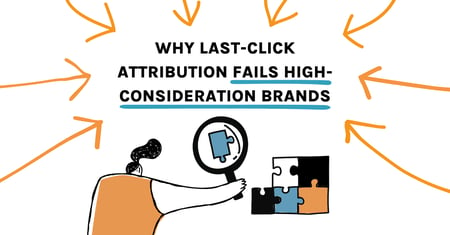
Every conversion has a last click, and most analytics dashboards give that last click alllll the credit.
The problem is that for high-consideration buyers, the last click is rarely where the work happened. By the time someone searches your brand or clicks that final ad, they’ve probably spent weeks researching, comparing options, reading case studies, and making up their mind. The last click just happened to be standing there when the decision landed.
For brands with long sales cycles and buyers who take their time, this creates a gap between what the data shows and what drove the conversion (and that gap has a way of showing up in budget decisions). Here’s what last-click attribution misses and how to build a more complete picture.
What Is Last-Click Attribution?
Last-click attribution is what it sounds like. A buyer converts, and the last touchpoint they interacted with gets 100% of the credit. The email they opened three weeks ago? Irrelevant. The blog post that introduced them to the brand? Doesn’t count. Whatever they clicked right before submitting the form wins.
It became the default for understandable reasons. Last-click attribution is easy to set up and built into basically every analytics platform that exists. It gives a clear answer to a tougher question: what drove this conversion? For marketing teams that need to show results fast, that’s useful.
However, it’s a better fit for buyers who research for five minutes than for buyers who research for five months.
Why Last-Click Attribution Falls Short for High-Consideration Brands
High-consideration buyers don’t convert the way last-click attribution assumes. They research for weeks or months, revisit your site multiple times, talk to colleagues, and slowly build enough confidence to commit…all before that final click happens. As a marketing attribution model, last-click captures the final moment of a long customer journey and calls it the whole story. It’s a bit like crediting the waiter who brought the check for cooking the meal.
Some places where that creates problems:
Long sales cycles change what a touchpoint means
When the path to purchase stretches over 60, 90, or 180 days, early touchpoints are doing way different work than late ones.
- The first interaction builds awareness.
- Mid-journey content helps buyers evaluate options and make the internal case.
- The final touchpoint closes something that was mostly decided.
The last-click attribution model treats the first 95% of that complex sales cycle like it never happened.
Buyers move across channels in ways last-click attribution can’t follow
A buyer might find you through organic search, come back through a paid ad, read a case study after clicking an email, and then convert after typing your brand name directly. Each touchpoint contributed something to the conversion path. Last-click attribution credits one touchpoint and ignores the rest, so the channels doing the most work to build awareness and trust rarely show up in marketing measurement as they deserve.
Multiple stakeholders mean multiple journeys
In plenty of high-consideration purchases, more than one person influences the decision. A procurement team, a manager, a spouse who has input—each might have done their own research. The last-click attribution model captures one path through one person, and everything else that shaped the decision is essentially invisible.
The last click didn’t create the demand
This is the core issue with last-touch attribution. By the time a buyer searches your brand name or clicks that final ad, they’ve done most of their deciding. Last-click gets the trophy, but the content, campaigns, and multiple touchpoints that built the relationship and earned the trust? Those are what made the conversion possible, and in a last-click model, they get zilch.
What Last-Click Attribution Causes Marketers to Miss
The gaps that last-click attribution creates are (unfortunately) budget problems. When credit flows only to the final touchpoint, the conclusions that follow can point marketing investment in the wrong direction. For high-consideration brands, the wrong direction can mean a lot of wasted money.
Here’s what tends to get missed:
Upper-funnel marketing loses its case
Awareness campaigns, educational content, and social touchpoints that introduce a brand to a buyer typically don’t show up as the last click. In a last-click world, that makes them look like they’re doing nothing. Over time, that narrative leads to underinvestment in the channels and content that create demand in the first place. The upper funnel gets cut, the pipeline quietly shrinks, and everyone wonders why.
Assisted conversions disappear from the story
Most analytics platforms can show assisted conversions, aka the touchpoints that appeared earlier in the customer journey before the final click. In a last-click attribution model, those contributions are removed from the report entirely. A paid social campaign that introduced a buyer to the brand six weeks before they converted gets zero credit, even if it's why they started paying attention. The data says it never happened (rude, we know).
How channels work together gets lost
Cross-channel marketing works because channels do different jobs at different stages of the buyer journey.
- Organic search builds authority.
- Content creates trust.
- Email nurtures existing interest.
- Paid media can accelerate consideration.
Last-click attribution turns that beautifully collaborative picture into a competition where one channel wins, and everything else looks like a line item without a return. Nobody wins that version of the game.
Budget decisions are made on an incomplete foundation
This is where the marketing measurement problem becomes a business problem. When investment decisions rely on last-click data alone, lower-funnel channels get overvalued because they’re always closest to the conversion. Upper and mid-funnel channels are then starved of resources because they can’t prove their impact in the same tidy way. For high-consideration brands with long sales cycles, that imbalance erodes the top of the funnel and, eventually, the bottom, too.
Moving Beyond Last-Click Attribution
Alright, we do have some good news here: the fix isn’t finding a perfect attribution model (because that doesn’t exist!). Every approach assumes something about how buyers decide, and no single one fully captures the complexity of a high-consideration customer journey. Searching for the perfect model is a great way to spend a lot of time and still end up frustrated.
What helps is shifting the question. Instead of asking “which channel gets the credit?” start asking “what helped move this buyer toward a decision?” That reframe sounds subtle, but it changes what you measure and what you do with it.
Multi-touch attribution: a fuller picture
Instead of handing 100% of the credit to the last click, multi-touch attribution distributes it across the touchpoints that showed up throughout the journey. The specific model matters less than the mindset shift from winner-take-all to a more honest view of what drove the conversion. Any version of that is a step up from last-click attribution doing all the talking.
Incrementality: did the marketing cause it?
Multi-touch attribution tells you which touchpoints appeared before a conversion. Incrementality testing answers a different and equally important question: would this buyer have converted anyway, without that campaign? Because not every channel that shows up before a conversion caused it. Understanding which marketing activity drives decisions vs. which ones are basically hitchhiking helps high-consideration brands put budget where it moves the needle.
Give the last-click better company
Last-click data still has a place. It just shouldn’t be the only voice in the room. For brands whose buyers take their time and need to be met across multiple touchpoints before they commit, combining attribution signals tells a more accurate story than any model ever could solo.
A Better Way to Measure High-Consideration Customer Journeys
Better measurement for high-consideration brands starts with one honest acknowledgment: the journey is messy, and any framework that pretends otherwise will produce misleading data. The goal is to build measurement that reflects how your buyers research, evaluate, and decide. Here’s how you can do so.
Look at the full conversion path
Most analytics platforms can show the full sequence of touchpoints that preceded a conversion, so starting there immediately changes the picture. Channels that consistently appear early in the journey for buyers who convert are doing something important, even if they never get the last click.
Connect marketing activity to buyer behavior to business outcomes
With marketing measurement, you want to understand how marketing activity influences what buyers do next and whether that leads to revenue. That means looking at how touchpoints work together across the customer journey instead of how individual channels perform when they’re treated like isolated experiments.
Build an attribution window that reflects how your buyers buy
This one sounds almost too simple, but it matters. If your buyers take 90 days to convert, a 30-day attribution window is going to miss most of the journey and misrepresent what’s driving results. Matching the measurement window to the sales cycle length is a small change that can shift what the data shows and what marketing decisions it supports.
Use multiple signals together
No single metric tells the entire story for a high-consideration brand, and anyone who says otherwise is probably selling something. Multi-touch attribution, assisted conversion data, incrementality insights, and channel performance used together create a marketing measurement framework that’s built for the complexity of a long buying cycle. Each signal adds context the others can’t provide on their own, and together, they tell something that resembles the truth.
Create a More Complete View of Marketing Performance
Now don’t get us wrong—last-click attribution data isn’t worthless. It’s just incomplete. For high-consideration brands, incomplete data leads to incomplete decisions, and incomplete decisions can defund the marketing doing the most important work in the journey.
Creating a more complete view of marketing performance means treating measurement the same way good marketing treats the buyer journey: as something that unfolds over time, across multiple touchpoints, with different things happening at every stage.
Start optimizing for contribution
The shift from “which channel got the credit?” to “which touchpoints contributed to this decision?” sounds like a small wording change, but it’s not. Channel investment, content strategy, and budget allocation look different when you measure contribution across the full customer journey instead of handing a gold star to whoever happened to show up last. That shift can change where money goes and what gets built.
Make measurement match the complexity of the sale
High-consideration brands have buyers who research deeply, evaluate carefully, and take their sweet time. The marketing attribution model should reflect that reality. When measurement matches the complexity of the sale, the data stops rewarding the last click and starts revealing what builds relationships, creates demand, and moves buyers forward over the long sales cycle they’re on.
This is where BFO and BlueFrame™ come in
Fixing attribution for a complex customer journey requires more than swapping one model for another and calling it a day. It requires a measurement approach built specifically for brands whose buyers research for months and definitely do not convert in a single session. BlueFrame™ is BFO’s framework for doing that: connecting marketing activity to buyer behavior to business outcomes across the full length of a high-consideration journey. That way, your investment decisions are based on what’s working rather than what happened to be clicked last.
The Last Click Didn’t Do It Alone
Last-click attribution gives full credit to the conversion, but it was a team effort. It was built over weeks of touchpoints, content that showed up at the right moment, channels that worked together without a group chat, and a buyer who needed to feel confident before committing. Last-click attribution just happened to be standing at the finish line with a camera.
For high-consideration brands, measurement that captures only the final moment leaves most of the story untold. That’s a strategy problem, because what isn’t measured doesn’t get invested in, and what isn’t invested in eventually stops showing up when buyers need it most.
If you want to understand how your marketing is performing across the full journey, that’s exactly what BFO and BlueFrame™ are built for. Send us a message today to chat with us about it!


SUBSCRIBE TO OUR BLOG
Stay up to date with the latest industry best practices in digital marketing!